
Disciplina partidaria en la legislatura brasileña
Palabras clave:
Brasil, legislaturas, partidos, presidentes, disciplina, votaciónResumen
Este artculo adapta la teora de los partidos legislativos al casod e Brasil. Demuestra que los presidentes brasileos son poderosos pero no dominantes. La explicacin se encuientra en la naturaleza de los partidos legislativos. Dadas las reglas electroales y la estructura federal, Brasil debera ser un caso de "gobierno de partido condicional", donde la influencia fluye de los miembros a los lderes. El artculo somete a prueba este modelo, utilizando votaciones nominales para estimar la probabilidad de que los diputados cooperen con sus partidos. Elabora dos indicadores de la fuerza de los partidos: uno de ellos mide la capacidad de los lderes para hacer efectiva la cooperacin con el partido; el otro estima el xito de los diputados para consegur obras pblicas o controlar el acceso a los empleos en sus localidades. El artculo demuestra que las recomendaciones de los partidos raramente determina la cooperacin. Concluye sealando que la debilidad de los presidentes brasileos resulta de la incapacidad de los lderes de los partidos para persuadir a los diputados de que apoyen las propuestas del ejecutivo.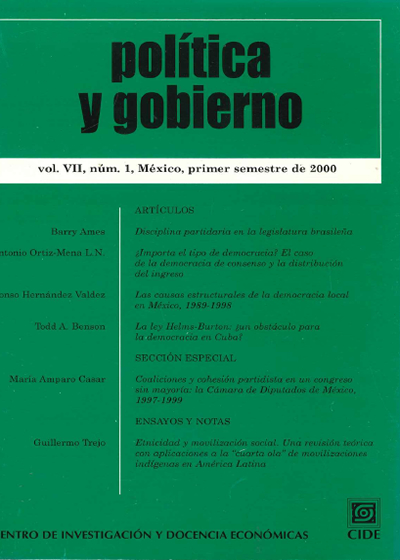
Descargas
Número
Sección
Licencia
Política de acceso abierto
Los autores/as que publiquen en esta revista aceptan las siguientes condiciones:
De acuerdo con la legislación de derechos de autor, Política y gobierno reconoce y respeta el derecho moral de los autores, así como la titularidad del derecho patrimonial, el cual será cedido a la revista para su difusión en acceso abierto. Política y gobierno no realiza cargos a los autores por enviar y procesar artículos para su publicación.
Todos los textos publicados por Política y gobierno –sin excepción– se distribuyen amparados bajo la licencia Creative Commons 4.0 Atribución-No Comercial (CC BY-NC 4.0 Internacional), que permite a terceros utilizar lo publicado siempre que mencionen la autoría del trabajo y a la primera publicación en esta revista.
Los autores/as pueden realizar otros acuerdos contractuales independientes y adicionales para la distribución no exclusiva de la versión del artículo publicado en Política y gobierno (por ejemplo incluirlo en un repositorio institucional o publicarlo en un libro) siempre que indiquen claramente que el trabajo se publicó por primera vez en Política y gobierno.
Para todo lo anterior, el o los autor(es) deben remitir el formato de Carta-Cesión de la Propiedad de los Derechos de la primera publicación debidamente requisitado y firmado por el autor(es). Este formato se puede enviar por correo electrónico en archivo pdf al correo: politicaygobierno@cide.edu (Carta-Cesión de Propiedad de Derechos de Autor).

Este obra está bajo una licencia de Creative Commons Reconocimiento-No Comercial 4.0 Internacional.






 Contacto