
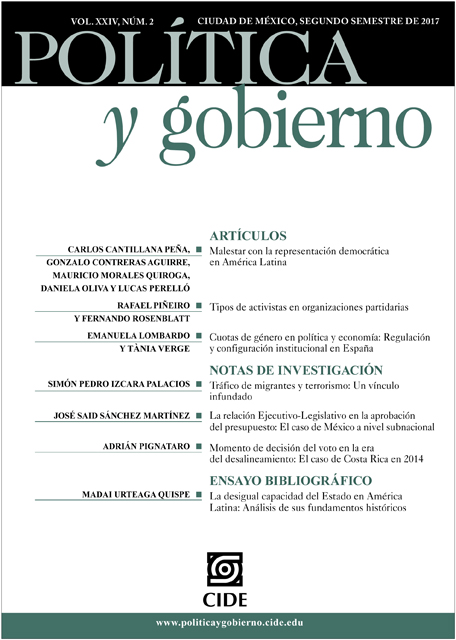
La desigual capacidad del Estado en América Latina: Análisis de sus fundamentos históricos
Keywords:
capacidad del Estado, construcción estatal, élites, siglo xix, América LatinaAbstract
América Latina se caracteriza por ser una región con Estados de capacidad intermedia, pero hay Estados, como el chileno, que son más fuertes que otros, como el peruano. ¿Qué factores explican estas divergencias? Partiendo del institucionalismo histórico, los tres libros revisados (Kurtz, 2013; Saylor, 2014; Soifer, 2015) pretenden responder esta interrogante al resaltar diferentes tipos de causas históricas. La principal lección es que factores estructurales, condiciones económicas, sociales, políticas y geográficas, determinaron poderosamente decisiones y acciones de las élites políticas y económicas que dieron lugar a la emergencia, éxito o fracaso de las empresas de construcción estatal. Sin embargo, el énfasis en estos factores pasa por alto otras condiciones importantes para entender mejor las trayectorias diferenciadas de la capacidad estatal en la región, como la autonomía estatal, el régimen político, la presión de las masas, los mecanismos de reproducción de fortaleza o debilidad estatal y las posibilidades de cambio que han tenido lugar más allá del siglo xix en América Latina.
Downloads
Published
Issue
Section
License
The authors who publish in this journal agree on the following conditions:
In accordance with copyright laws, Política y gobierno recognizes and respects the authors’ moral rights, as well as the ownership of property rights, which will be transferred to the journal for its dissemination in open access. Política y gobierno does not charge the authors for submitting and processing articles for publication.
All the articles published in Política y gobierno —with no exception— are distributed under a Creative Commons License 4.0 Attribution Non-Commercial (CC BY-NC 4.0 International), that allows third parties to use the published work providing they mention the authorship of the work and the first publication in this journal.
The authors can enter into other independent and additional contractual arrangements for the non-exclusive distribution of the version of the article published in Política y gobierno (for example to include it into an institutional repository or publish it in a book) as lomg as it is clearly indicated that the work was published for the first time in Política y gobierno.
For all of the above, the author(s) must submit the Format of transfer of the ownership of the first publishing rights duly filled in and signed by the author(s). This format can be sent as a pdf by e-mail: politicaygobierno@cide.edu (Letter- transfer of property rights)

This work is licensed under a Creative Commons Attribution-Noncommercial 4.0 International.






 Contact