
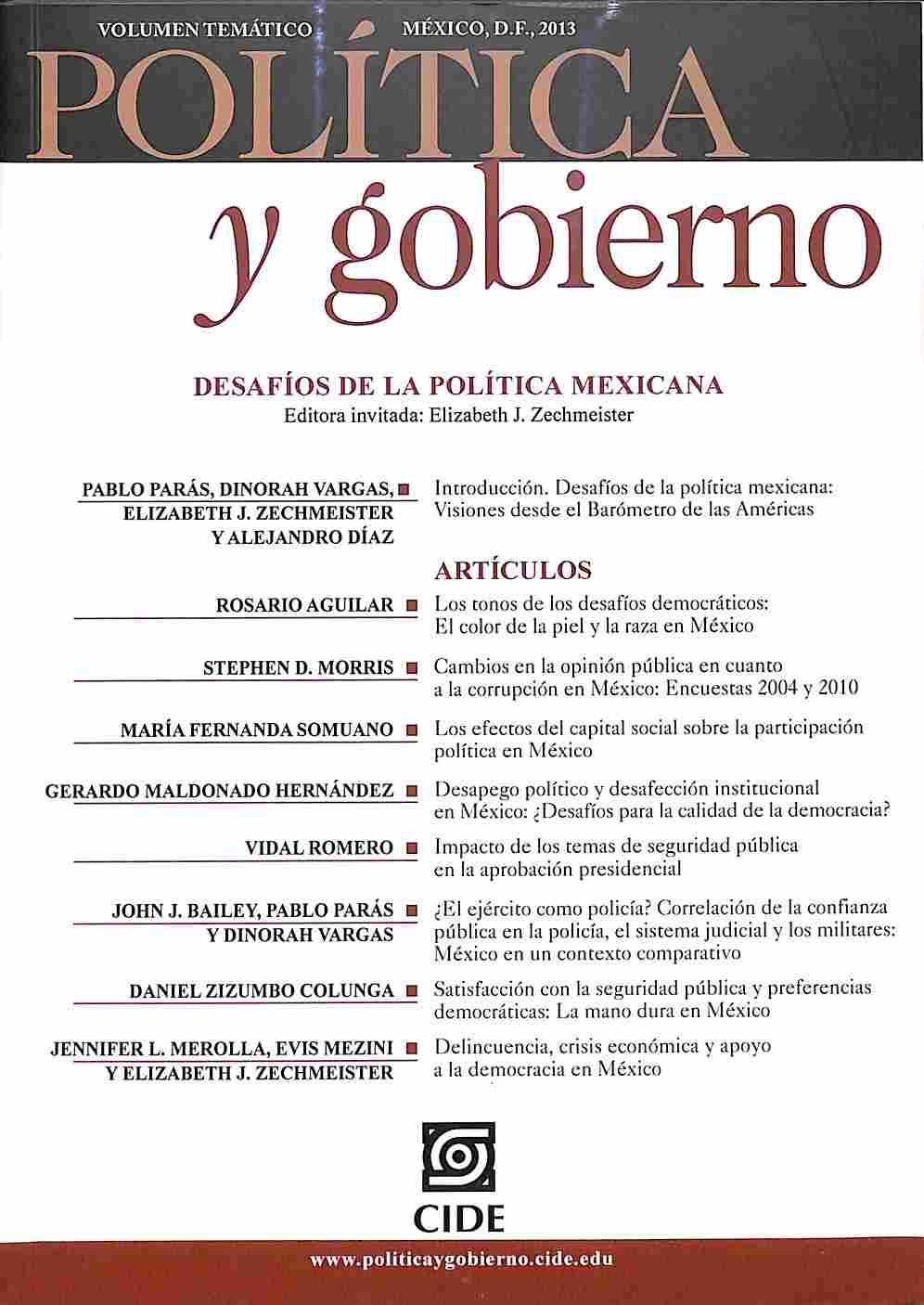
The Tones of Democratic Challenges: Skin Color and Race in México
Keywords:
intergroup conflict, democratization, discrimination, skin tone, racial identification, political attitudes.Abstract
In this paper I analyze the effect of skin tone and racial identity on Mexicans' political attitudes. I also test different intergroup conflict theories to assess which one explains Mexico's situation better if we look at skin tone and racial identification as independent variables. In order to test my hypotheses I use the Americas Barometer data from México 2010 that includes a measure of respondents' skin tone. The results show that people's skin tone not only affects their political attitudes but their income as well, once controlling for education, age and gender. Moreover, the theory of social identity explains better the Mexican case than other theories. The conclusions show that Mexico's democracy faces the challenge of political inclusión of all its citizens regardless of their skin tone or racial identification.
Downloads
Published
Issue
Section
License
The authors who publish in this journal agree on the following conditions:
In accordance with copyright laws, Política y gobierno recognizes and respects the authors’ moral rights, as well as the ownership of property rights, which will be transferred to the journal for its dissemination in open access. Política y gobierno does not charge the authors for submitting and processing articles for publication.
All the articles published in Política y gobierno —with no exception— are distributed under a Creative Commons License 4.0 Attribution Non-Commercial (CC BY-NC 4.0 International), that allows third parties to use the published work providing they mention the authorship of the work and the first publication in this journal.
The authors can enter into other independent and additional contractual arrangements for the non-exclusive distribution of the version of the article published in Política y gobierno (for example to include it into an institutional repository or publish it in a book) as lomg as it is clearly indicated that the work was published for the first time in Política y gobierno.
For all of the above, the author(s) must submit the Format of transfer of the ownership of the first publishing rights duly filled in and signed by the author(s). This format can be sent as a pdf by e-mail: politicaygobierno@cide.edu (Letter- transfer of property rights)

This work is licensed under a Creative Commons Attribution-Noncommercial 4.0 International.






 Contact