
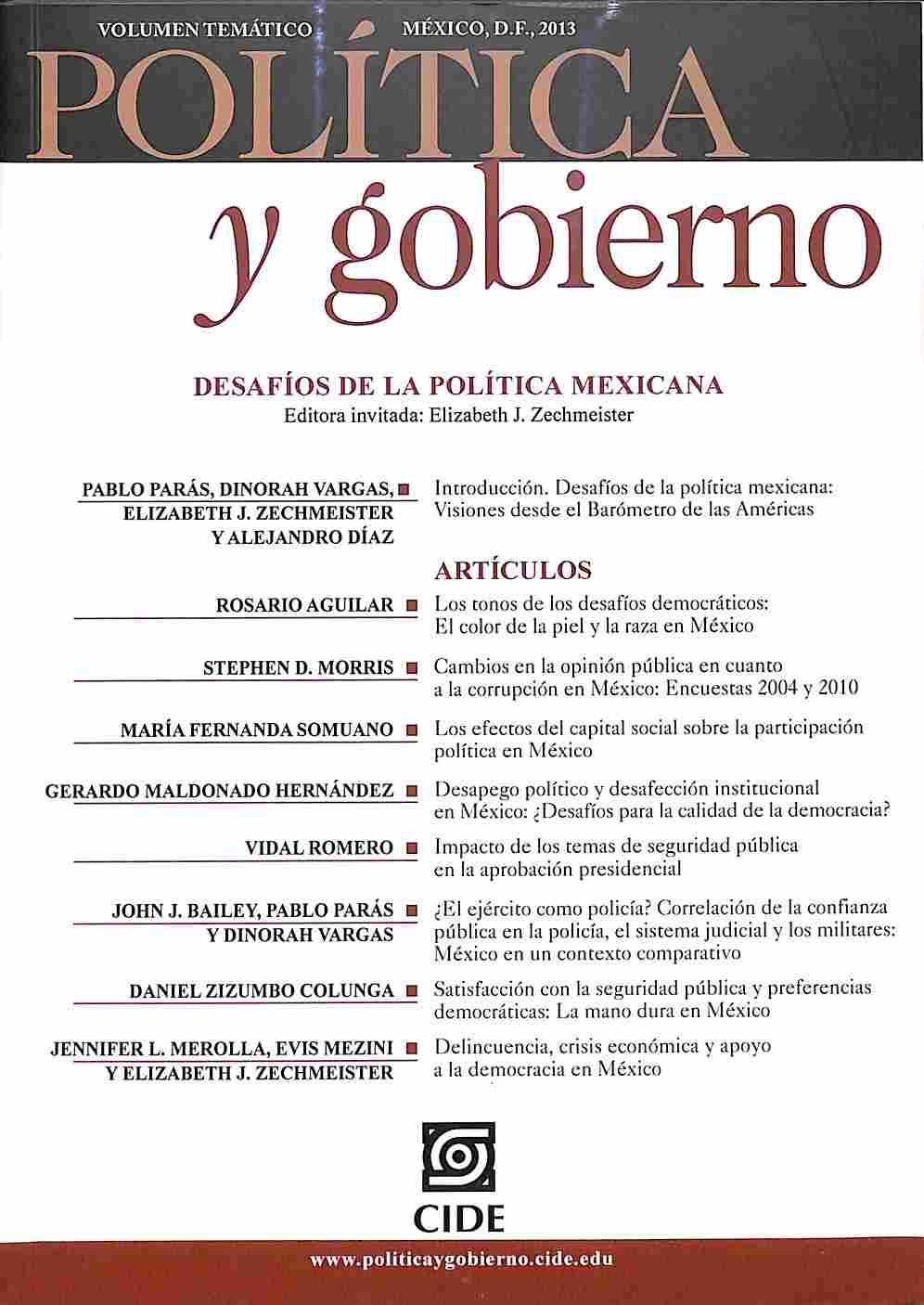
Impact of Public Safely Thmes on Presidential Approval
Keywords:
public safecy, presidential approval, organizcd crimeAbstract
One of the main problems that developíng countries face is the increasing presence of organized crime; a presence that,in many cases, has weakened the structure of the State. Some govenments choose to combat these illegal organizations while others decide to either ignore them or collude with them. We would expect that, as it occurs with any other public policy, the governmental decisions to fígh t organizced crímc would grcaily depend on thc anticipated response of public Opinión to this type of public policy. Unlike other determinats —the economy, for instance— iew studies have been done on the effects of anti-crime policies on the assessment of presidents. Using data from the LAPOP 2010 survey for the case of México, I study the impact ofseveral dimensions of the public safecy themeon presidential approval. I find that che assessment ofpublic safecy perfomance has an important impact on approval. On che other hand, 1 aiso flnd that public support for a specific approach to fighting crime, die quasi-dircct effect gcncrated by lack of safecy, and the percepción of public safecy as che central probiem, have a relaciveiy lower —but none theless meaningful— impact on approval. It was somewhat surprising not to discover meaningful effeccs on approval from victims of crime or persons who fear insecurity
Downloads
Published
Issue
Section
License
The authors who publish in this journal agree on the following conditions:
In accordance with copyright laws, Política y gobierno recognizes and respects the authors’ moral rights, as well as the ownership of property rights, which will be transferred to the journal for its dissemination in open access. Política y gobierno does not charge the authors for submitting and processing articles for publication.
All the articles published in Política y gobierno —with no exception— are distributed under a Creative Commons License 4.0 Attribution Non-Commercial (CC BY-NC 4.0 International), that allows third parties to use the published work providing they mention the authorship of the work and the first publication in this journal.
The authors can enter into other independent and additional contractual arrangements for the non-exclusive distribution of the version of the article published in Política y gobierno (for example to include it into an institutional repository or publish it in a book) as lomg as it is clearly indicated that the work was published for the first time in Política y gobierno.
For all of the above, the author(s) must submit the Format of transfer of the ownership of the first publishing rights duly filled in and signed by the author(s). This format can be sent as a pdf by e-mail: politicaygobierno@cide.edu (Letter- transfer of property rights)

This work is licensed under a Creative Commons Attribution-Noncommercial 4.0 International.






 Contact