
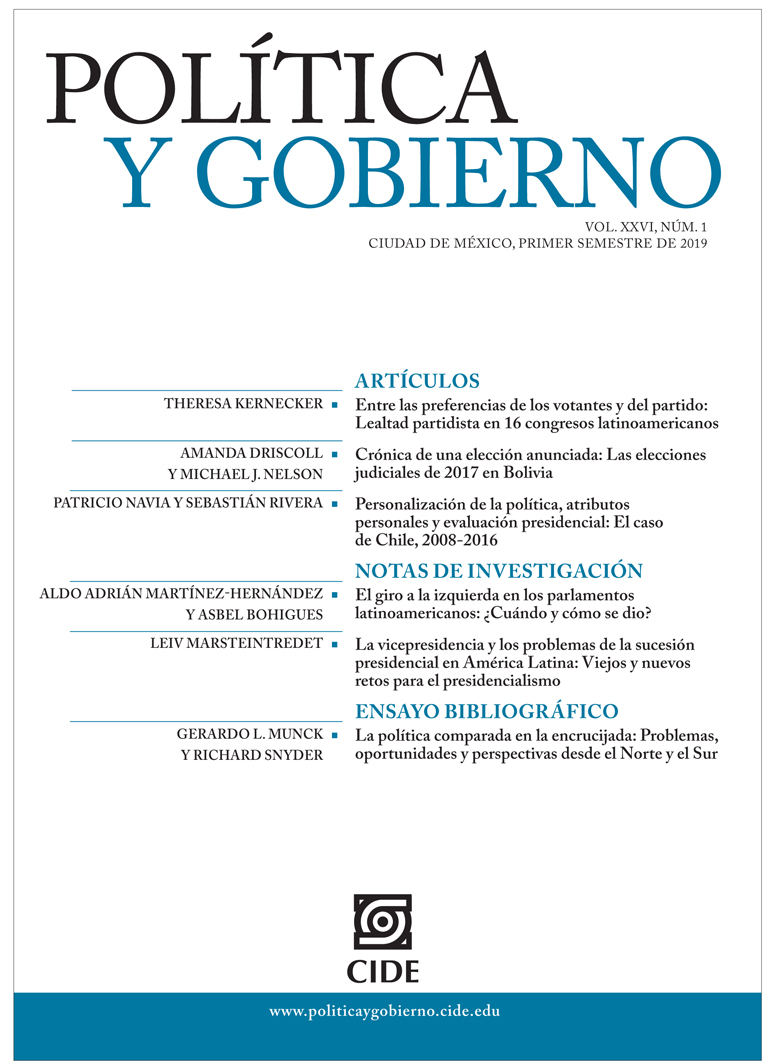
La política comparada en la encrucijada: Problemas, oportunidades y perspectivas desde el norte y el sur/Comparative Politics at a Crossroad: Problems, Opportunities and Prospects from the North and South
Keywords:
política comparada, teoría, métodos, colaboración norte-sur, producción de conocimiento, economía política de la investigaciónAbstract
¿Cómo ha evolucionado la Política Comparada en Estados Unidos desde el cambio de milenio? ¿Qué pueden hacer los investigadores de América Latina, un contexto de trabajo diferente al de Estados Unidos, para contribuir a la política comparada? Los académicos estadounidenses actualmente dan una atención desproporcionada a cuestiones de método, tienden a abordar preguntas sustantivas estrechas y prestan poca atención a cuestiones de teoría. Sin embargo, la comunidad de investigadores en Estados Unidos es diversa, y ninguna tendencia domina mucho tiempo. A su vez, pocos investigadores en América Latina trabajan en las circunstancias conducentes a carreras plenamente enfocadas en la investigación, a diferencia de sus pares en Estados Unidos. Aun así, hay ventajas de trabajar en la periferia, que incluyen un mayor conocimiento de las lenguas y culturas, una capacidad superior para producir “conocimiento denso” y contextualizado, y una proximidad a los fenómenos empíricos de interés que puede hacer más obvio que es lo que está en juego en la investigación. Además, los académicos latinoamericanos pueden beneficiarse al vincularse selectivamente con ideas y colegas en el norte. Por lo tanto, vemos no sólo problemas y obstáculos sino también oportunidades para la política comparativa tanto en el norte como en el sur.
How has the field of comparative politics in the US evolved since the turn of the millennium? What might a scholar based in Latin America, a different working environment than the United States, do to contribute to comparative politics? Researchers in the US currently give disproportionate attention to matters of methods, tend to address narrow substantive questions, and pay inadequate attention to matters of theory. However, the research community in the US is diverse, and no trend dominates for long. In turn, few researchers in Latin America work in the kinds of circumstances conducive to careers focused fully on research that their peers in the US enjoy. Still, there are advantages to working in the periphery, including greater knowledge of the languages and cultures, a stronger ability to produce “thick knowledge” that sets research in context, and closer proximity to empirical phenomena of interest that can make the stakes of research more obvious. Moreover, Latin American scholars can benefit from selectively engaging with ideas and colleagues from the North. We thus see not only problems and obstacles but also opportunities for comparative politics in both the North and South.
Published
Issue
Section
License
The authors who publish in this journal agree on the following conditions:
In accordance with copyright laws, Política y gobierno recognizes and respects the authors’ moral rights, as well as the ownership of property rights, which will be transferred to the journal for its dissemination in open access. Política y gobierno does not charge the authors for submitting and processing articles for publication.
All the articles published in Política y gobierno —with no exception— are distributed under a Creative Commons License 4.0 Attribution Non-Commercial (CC BY-NC 4.0 International), that allows third parties to use the published work providing they mention the authorship of the work and the first publication in this journal.
The authors can enter into other independent and additional contractual arrangements for the non-exclusive distribution of the version of the article published in Política y gobierno (for example to include it into an institutional repository or publish it in a book) as lomg as it is clearly indicated that the work was published for the first time in Política y gobierno.
For all of the above, the author(s) must submit the Format of transfer of the ownership of the first publishing rights duly filled in and signed by the author(s). This format can be sent as a pdf by e-mail: politicaygobierno@cide.edu (Letter- transfer of property rights)

This work is licensed under a Creative Commons Attribution-Noncommercial 4.0 International.






 Contact