
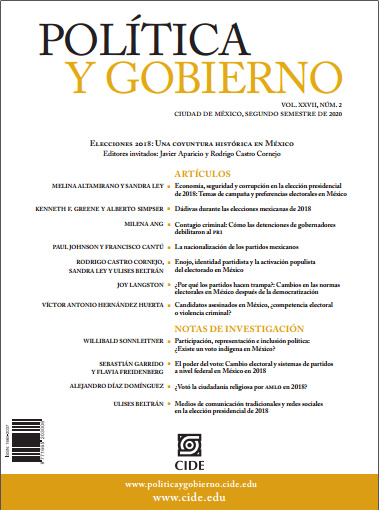
The Economy, Security, and Corruption in the 2018 Presidential Election Campaign Issues and Electoral Preferences in Mexico
Keywords:
issue voting, elections, economic voting, security, corruptionAbstract
Throughout Enrique Peña Nieto’s administration and during the 2018 presidential campaign, three problems stood out among the Mexican electorate: the limited economic growth, a sustained increase in violence, and multiple corruption scandals. Therefore, based on the CIDE-CSES 2018 National Electoral Study, we analyze the simultaneous effects of individual evaluations of the economy, violence and corruption on electoral preferences. Our fndings indicate the prevalence of a retrospective economic vote that coexists with a security vote, but without clear support from crime victims. Although corruption was widely discussed during the electoral campaign, this issue
did not play a major role in voter preferences.
References
Aidt, Toke S. 2000. “Economic voting and information.” Electoral Studies 19(2): 349-362.
Altheide, David L. 2002. Creating Fear. News and the Construction of Crisis. New
York: Aldine de Gruyter.
Anderson, Christopher. 2000. “Economic Voting and Political Context: A Comparative Perspective.” Electoral Studies 19:151–170.
Anderson, Christopher. 2007. “The End of Economic Voting? Contingency Dilemmas and Limits of Democratic Accountability.” Annual Review of Political Science 10:271–296.
Arceneaux, Kevin. 2006. “The federal face of voting: Are elected officials held accountable for the functions relevant to their office?” Political Psychology 27(5): 731-754.
Aristegui Noticias. 2014. “La casa blanca de Enrique Peña Nieto (investigación especial).” Aristegui Noticias, 9 de noviembre. https://aristeguinoticias.com/0911/mexico/la-casa-blanca-de-enrique-pena-nieto/
Arroyo Ortiz, Juan Pablo, Isabel Islas Arredondo, Ariadna Díaz Castillo, María Ángeles Cortés Basurto. 2018. Balance de las Reformas Estructurales. Tomo I. Ciudad de México: Instituto Belisario Dominguez
Ashby, Nathan J. y Miguel A. Ramos. 2013. “Foreign direct investment and industry response to organized crime: The Mexican case.” European Journal of Political Economy 30 (June): 80-91.
Bali, Valentina A. 2007. “Terror and Elections: Lessons from Spain.” Electoral Studies 26:669–687.
Barragán, Sebastián. 2018. “‘Perdón después de la justicia’, reiteran víctimas a López Obrador.” Aristegui Noticias, 14 de septiembre, https://aristeguinoticias.com/1409/lomasdestacado/perdon-despues-de-la-justicia-reiteran-victimas-a-lopez-obrador/
Becerra, Lorena. 2017. “Da ventaja a Morena desaprobación de EPN.” Reforma, https://gruporeforma.reforma.com/interactivo/encuestas/enc_13a_epn/#continuar
Benería, Lourdes, and Maria S. Floro. 2006. Labour Market Informalization, Gender and
Social Protection: Reflections on Poor Urban Households in Bolivia and Ecuador.
In Gender and Social Policy in a Global Context: Uncovering the Gendered
Structure of the Social, ed. Shahra Razavi and Shireen Hassim. London: Palgrave
Macmillan. 193-216.
Boas, Taylor C., F. Daniel Hidalgo y Marcus André Melo. 2018. “Norms versus Action: Why Voters Fail to Sanction Malfeasance in Brazil.” American Journal of Political Science https://doi.org/10.1111/ajps.12413
Botero, Sandra, Rodrigo Castro Cornejo, Laura Gamboa, Nara Pavão y David W. Nickerson. 2015. “Says Who? An Experiment on Allegations of Corruption and Credibility of Sources.” Political Research Quarterly 68(3):493–504.
Brown, Ryan. 2018. “The Mexican drug war and early-life health: the impact of violent crime on birth outcomes.” Demography 55 (1): 319-340.
Brown, Ryan, and Andrea Velásquez. 2017. “The effect of violent crime on the human capital accumulation of young adults.” Journal of Development Economics 127 (Julio): 1-12.
Buendía y Laredo. 2018. “Aprobación Presidencial.” Buendía y Laredo, http://buendiaylaredo.com/publicaciones/444/APROBACION.pdf
Cacelin, Janet. 2018. “Cifras récord de asesinatos, desapariciones e impunidad: el balance que deja Peña Nieto al terminar mandato.” Univisión, 29 de Noviembre. https://www.univision.com/noticias/america-latina/cifras-record-de-asesinatos-desapariciones-e-impunidad-el-balance-que-deja-pena-nieto-al-terminar-mandato
Caudillo, Monica L., and Florencia Torche. 2014. “Exposure to local homicides and early educational achievement in Mexico.” Sociology of Education 87(2): 89-105.
Carreras, Miguel. 2013. “The impact of criminal violence on regime legitimacy in Latin America.” Latin American Research Review 48(3): 85-107.
Chang, Eric C. C., Miriam A. Golden and Seth J. Hill. 2010. “Legislative Malfeasance and Political Accountability.” World Politics 62(2):177–220.
Chiricos, Ted, Kathy Padgett y Marc Gertz. 2000. “Fear, TV News, and the Reality of Crime.” Criminology 38(3):755–786.
Chong, Alberto, Ana de la O, Dean Karlan y Leonard Wantchekon. 2015. “Does corruption information inspire the fight or quash the hope? A field experiment in Mexico on voter turnout, choice, and party identification.” Journal of Politics 77(1):55–71.
Dorussen, Han and Harvey D. Palmer. 2002. The Context of Economic Voting: An Introduction. In Economic Voting, ed. Han Dorussen and Michael Taylor. New York: Routledge pp. 1–14.
Estudio Nacional Electoral de México (ENEM). 2018.
Ferraz, Claudio and Frederico Finan. 2008. “Exposing Corrupt Politicians: The Effects of Brazil’s Publicly Released Audits on Electoral Outcomes.” Quarterly Journal of Economics 123(2):703–745.
Flores-Macías, Gustavo. 2016. “Latin America’s New Turbulence: Mexico’s Stalled Reforms.” Journal of Democracy 27(2): 66-78
Gelineau, Francois, and Karen L. Remmer. 2006. “Political decentralization and electoral accountability: The Argentine experience, 1983–2001.” British Journal of Political Science 36(1): 133-157.
Ghai, D. 2003. Trabajo decente. Concepto e indicadores, Revista Internacional del Trabajo, 122(2)
Gomez, Brad T., and J. Matthew Wilson. 2001. “Political sophistication and economic voting in the American electorate: A theory of heterogeneous attribution.” American Journal of Political Science 45(4): 899-914.
Hetherington, Marc J. 1996. “The media's role in forming voters' national economic evaluations in 1992.” American Journal of Political Science 40(2): 372-395.
Hobolt, Sara, James Tilley, and Susan Banducci. 2013. “Clarity of responsibility: How government cohesion conditions performance voting.” European Journal of Political Research 52(2): 164-187.
Holbrook, Thomas y James C. Garand. 1996. “Homo economus? Economic information and economic voting.” Political Research Quarterly 49(2):351–75
Kibris, Arzu. 2011. “Funerals and Elections: The Effects of Terrorism on Voting
Behavior in Turkey.” Journal of Conflict Resolution 55(2):220–247.
Krosnick, Jon A. 1990. “Government policy and citizen passion: A study of issue
publics in contemporary America.” Political Behavior 12(1):59–92.
Ley, Sandra. 2017. “Security and Crime Issue Voting: Electoral Accountability in the Midst of Violence.” Latin American Politics and Society 59(1): 3-27.
Ley, Sandra. 2018. “To Vote or Not to Vote: How Criminal Violence Shapes Electoral Participation.” Journal of Conflict Resolution 62(9): 1963-1990
Manzetti, Luigi y Guillermo Rosas. 2015. “Corruption and the Latin American Voter.” In Carlin, Ryan E., Matthew M. Singer y Elizabeth J. Zechmeister. The Latin American Voter: Pursuing Representation and Accountability in Challenging Contexts. Ann Arbor: University of Michigan Press, pp. 313-356.
Mauro, Paolo. 1995. “Corruption and Growth,” Quarterly Journal of Economics 110(3): 681–712.
Mauro, Paolo. 1997. “The Effects of Corruption on Growth, Investment and Government Expenditure,” Journal of Public Economics, 69: 263-79.
Mishler, William and Richard Rose. 2001. “What are the origins of Political Trust? Testing
Institutional and Cultural Theories in Post-Communist Societies,” Comparative Political
Studies 34(1):30-62.
Montes, Juan. 2014. “Mexico Finance Minister Bought House From Government Contractor.” Wall Street Journal, 11 de diciembre. https://www.wsj.com/articles/new-ties-emerge-between-mexico-government-and-builder-1418344492
Pacek, Alexander C. and Benjamin Radcliff. 1995. “Economic Voting and the Welfare State: A Cross-National Analysis.” Journal of Politics 57(1):44–61.
Pavão, Nara. 2018. “Corruption as the Only Option: The Limits to Electoral Accountability.” Journal of Politics 80(3):996–1010.
Pérez, Orlando. 2015. “The Impact of Crime on Voter Choice in Latin America.” In Carlin, Ryan E., Matthew M. Singer y Elizabeth J. Zechmeister. The Latin American Voter: Pursuing Representation and Accountability in Challenging Contexts. Ann Arbor: University of Michigan Press, pp. 337-358.
Phillips, Brian J. 2017. “Inequality and the emergence of vigilante organizations: the case of Mexican autodefensas.” Comparative Political Studies 50(10): 1358-1389.
Powell, Bingham and Guy Whitten. 1993. “A Cross-National Analysis of Economic Voting: Taking Account of the Political Context.” American Journal of Political Science 37(2):391–414.
Reporte Indigo. 2018. “Meade retrata ‘miedo’ de la sociedad a AMLO en nuevos spots.” Reporte Indigo, 9 de abril, https://www.reporteindigo.com/reporte/meade-retrata-miedo-la-sociedad-a-amlo-en-nuevos-spots-videos/
Robles, Gustavo, Gabriela Calderón y Beatriz Magaloni. 2013.“The Economic Consequences of Drug-Trafficking Violence in Mexico,”. Banco Interamericano de Desarrollo, Documento de Trabajo 42, Washington D.C: Banco Interamericano de Desarrollo.
Romero, Vidal, Beatriz Magaloni y Alberto Díaz-Cayeros. 2016. “Presidential Approval and Public Security in Mexico's War on Crime." Latin American Politics and Society 58(2): 100-123.
Rose-Ackerman, Susan. 1999. Corruption and Government: Causes, Consequences and Reform. New York: Cambridge University Press.
Seligson, Mitchell. 2002. “The Impact of Corruption on Regime Legitimacy: A Comparative Study of Four Latin American Countries,” Journal of Politics 64 (May):408-33.
Singer, Matthew M. 2011. “Who Says It’s the Economy? Cross-National and Cross-Individual Variation in the Salience of Economic Performance.” Comparative Political Studies 44(3):284–312.
Singer, Matthew M. 2016. Informal Sector Work and Evaluations of the Incumbent: The
Electoral Effect of Vulnerability on Economic Voting. Latin American Politics
and Society 58, 2: 49–73.
Trejo, Guillermo and Sandra Ley. 2019. “High-Profile Criminal Violence: Why Drug Cartels Murder Government Officials and Party Candidates in Mexico.” British Journal of Political Science.
Visconti, Giancarlo. 2019. “Policy Preferences after Crime Victimization: Panel and Survey Evidence from Latin America.” British Journal of Political Science (2019): 1-15.
https://doi.org/10.1017/S0007123418000297
Wei, Shang-Jin. 1999. “Corruption in Economic Development: Beneficial Grease, Minor
Annoyance, or Major Obstacle?,” World Bank Policy Research Working Paper 2444.
Washington D.C: World Bank.
Weitz-Shapiro, Rebecca and Matthew S. Winters. 2017. “Can Citizens Discern? Information Credibility, Political Sophistication, and the Punishment of Corruption in Brazil.” Journal of Politics 79(1):60–74.
Downloads
Published
Issue
Section
License
The authors who publish in this journal agree on the following conditions:
In accordance with copyright laws, Política y gobierno recognizes and respects the authors’ moral rights, as well as the ownership of property rights, which will be transferred to the journal for its dissemination in open access. Política y gobierno does not charge the authors for submitting and processing articles for publication.
All the articles published in Política y gobierno —with no exception— are distributed under a Creative Commons License 4.0 Attribution Non-Commercial (CC BY-NC 4.0 International), that allows third parties to use the published work providing they mention the authorship of the work and the first publication in this journal.
The authors can enter into other independent and additional contractual arrangements for the non-exclusive distribution of the version of the article published in Política y gobierno (for example to include it into an institutional repository or publish it in a book) as lomg as it is clearly indicated that the work was published for the first time in Política y gobierno.
For all of the above, the author(s) must submit the Format of transfer of the ownership of the first publishing rights duly filled in and signed by the author(s). This format can be sent as a pdf by e-mail: politicaygobierno@cide.edu (Letter- transfer of property rights)

This work is licensed under a Creative Commons Attribution-Noncommercial 4.0 International.






 Contact