
The Effect of Electoral Laws on the Partisan Fragmentation in Chile, 1999-2008: Strategic Vote, Barriers to Entry and Information
Keywords:
electoral systems, strategic vote, strategic entry, fragmentationAbstract
This article analyzes the effects of majoritarian formulas on the effective number of candidates in the elections for president (absolute majority) and mayor (relative majority) in Chile. Although, in theory, greater fragmentation with the absolute majority system with run-off voting would be expected, the authors demonstrate that, in the case of Chile, precisely the opposite is observed. Fragmentation is greater in the relative majority system. This is explained by the lower entry and information costs that exist in mayoral elections with respect to presidential ones. We support this hypothesis with a time series statistical model (cross-sectional time series regression model). We use electoral data added to the communal level for the 2004 and 2008 municipal elections, and for the 1999 and 2005 presidential elections.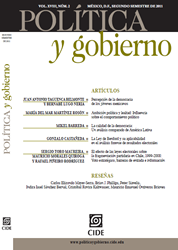
Downloads
Issue
Section
License
The authors who publish in this journal agree on the following conditions:
In accordance with copyright laws, Política y gobierno recognizes and respects the authors’ moral rights, as well as the ownership of property rights, which will be transferred to the journal for its dissemination in open access. Política y gobierno does not charge the authors for submitting and processing articles for publication.
All the articles published in Política y gobierno —with no exception— are distributed under a Creative Commons License 4.0 Attribution Non-Commercial (CC BY-NC 4.0 International), that allows third parties to use the published work providing they mention the authorship of the work and the first publication in this journal.
The authors can enter into other independent and additional contractual arrangements for the non-exclusive distribution of the version of the article published in Política y gobierno (for example to include it into an institutional repository or publish it in a book) as lomg as it is clearly indicated that the work was published for the first time in Política y gobierno.
For all of the above, the author(s) must submit the Format of transfer of the ownership of the first publishing rights duly filled in and signed by the author(s). This format can be sent as a pdf by e-mail: politicaygobierno@cide.edu (Letter- transfer of property rights)

This work is licensed under a Creative Commons Attribution-Noncommercial 4.0 International.






 Contact