
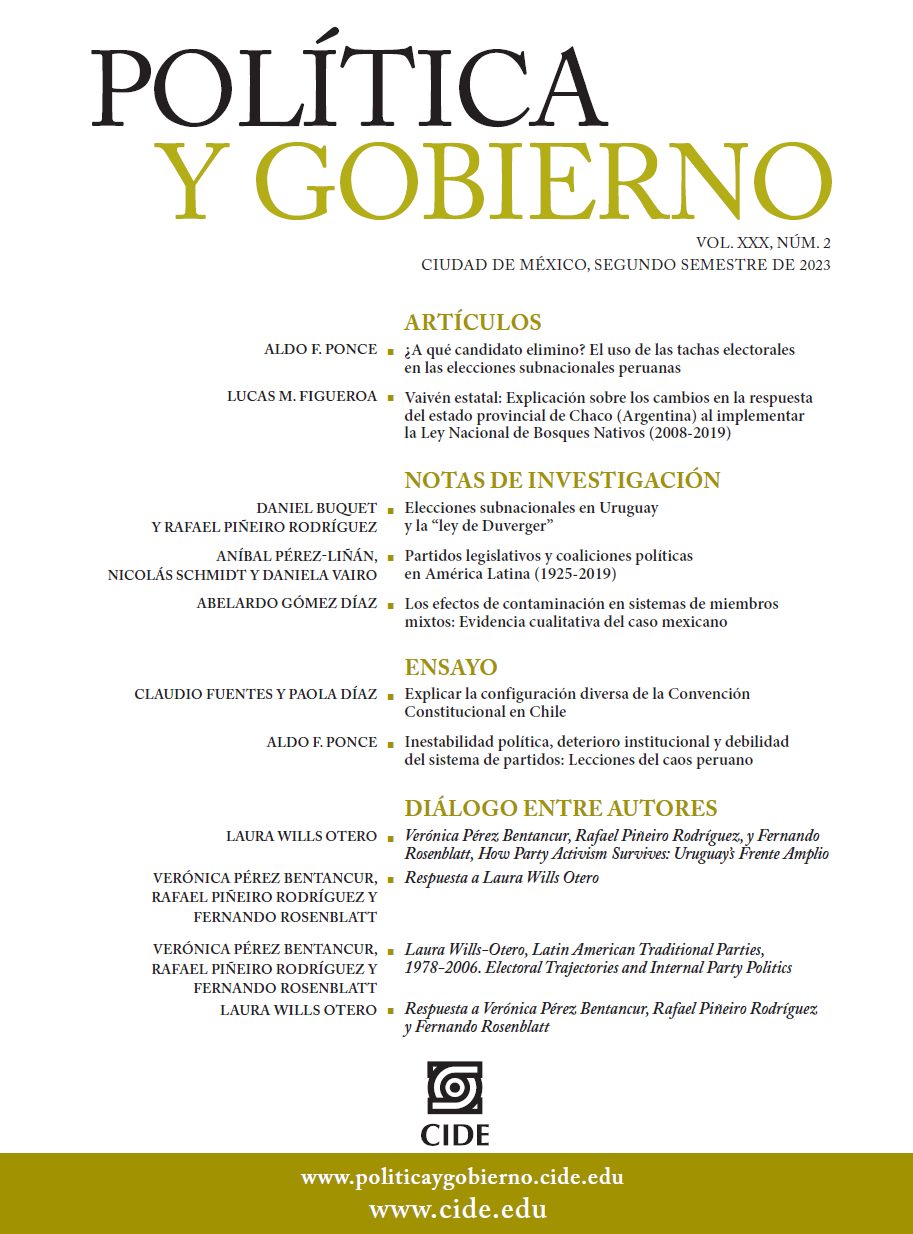
Political Instability, Institutional Deterioration and Weakness of the Party System: Lessons from the Peruvian Chaos
Keywords:
Peru, political system, Congress, political instability, institutional deteriorationAbstract
Since 2016, Peru has had seven presidents and has experienced two irregular dissolutions of Congress. How to explain this high political instability? This essay identifies the weakness of the Peruvian party system as the root cause of this political instability. This essay argues that the attack on political institutions in Peruvian politics was latent and with a high probability of breaking into the political scene given the significant weakness of Peruvian parties. Another factor that kept the assault on political institutions latent is the accentuated rivalry among Peruvian political parties. The weakness of the party system, which manifests itself with high volatility, contributed to the emergence of a wide imbalance of power among them. One of these parties (Popular Force) took advantage of this power imbalance for its own benefit to vacate a president and opened the opportunity for a relatively unknown politician to come to power (former President Martín Vizcarra). Vizcarra, a politician with legal issues, found the assault on political institutions effective to weaken his critics and gain popularity. Once the institutional deterioration intensified, as a result of these attacks, political instability amplified and led to more conflict and instability.
Downloads
Published
Issue
Section
License
The authors who publish in this journal agree on the following conditions:
In accordance with copyright laws, Política y gobierno recognizes and respects the authors’ moral rights, as well as the ownership of property rights, which will be transferred to the journal for its dissemination in open access. Política y gobierno does not charge the authors for submitting and processing articles for publication.
All the articles published in Política y gobierno —with no exception— are distributed under a Creative Commons License 4.0 Attribution Non-Commercial (CC BY-NC 4.0 International), that allows third parties to use the published work providing they mention the authorship of the work and the first publication in this journal.
The authors can enter into other independent and additional contractual arrangements for the non-exclusive distribution of the version of the article published in Política y gobierno (for example to include it into an institutional repository or publish it in a book) as lomg as it is clearly indicated that the work was published for the first time in Política y gobierno.
For all of the above, the author(s) must submit the Format of transfer of the ownership of the first publishing rights duly filled in and signed by the author(s). This format can be sent as a pdf by e-mail: politicaygobierno@cide.edu (Letter- transfer of property rights)

This work is licensed under a Creative Commons Attribution-Noncommercial 4.0 International.






 Contact