
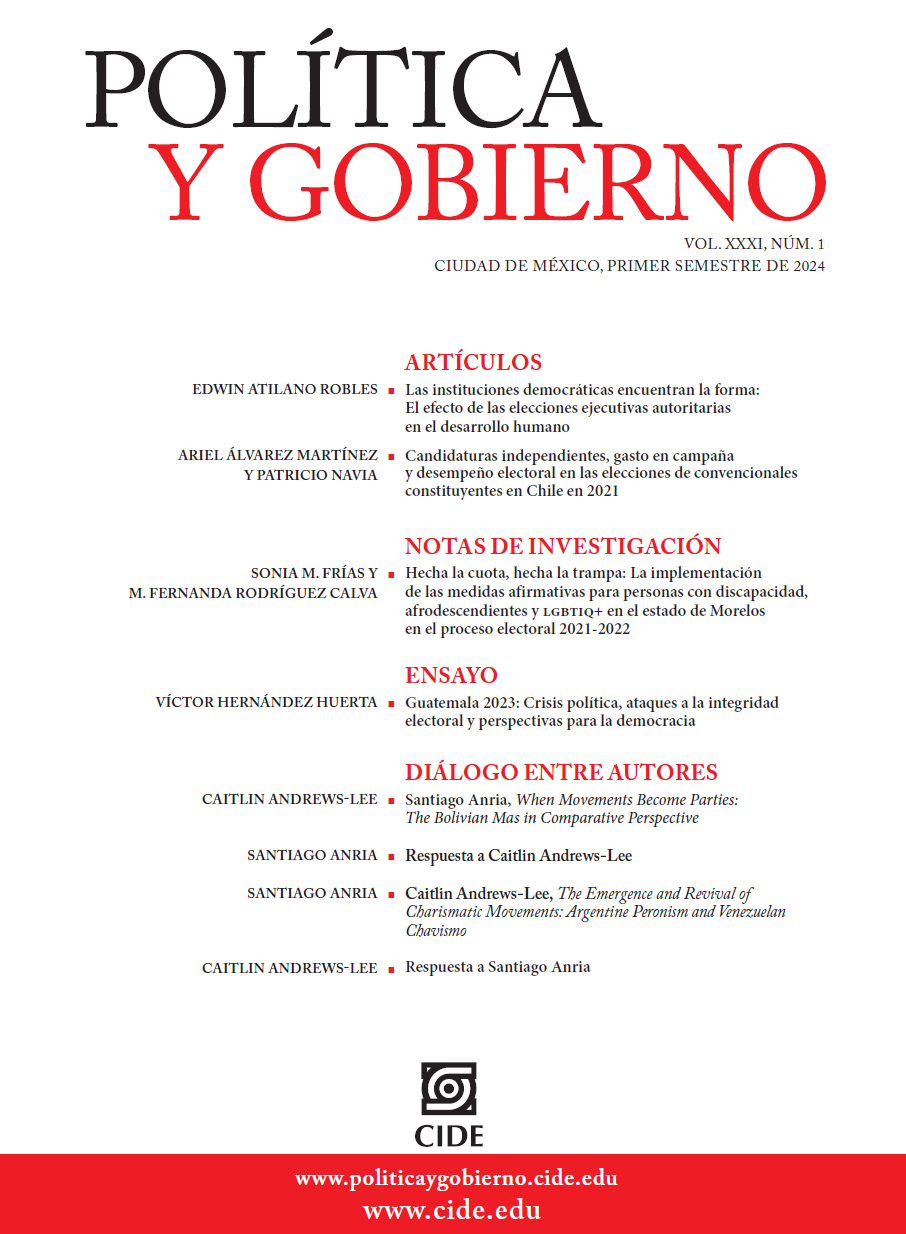
Guatemala 2023: Political Crisis, Attacks on Electoral Integrity and Prospects for Democracy
Keywords:
democratic erosion, Guatemala, presidential elections, electoral integrityAbstract
During 2023, Guatemala faced a political crisis marked by three critical moments that threatened democratic stability. The process of democratic weakening intensified during the general elections with the exclusion of prominent opposition candidates under fabricated accusations. Additionally, the Public Ministry attempted to suspend the legal status of the Semilla party before the second round, and accusations of fraud were leveled against Semilla by nine parties affiliated with the ruling coalition. These actions jeopardized democracy, triggering widespread international condemnation and intervention by the Organization of American States. Despite Arévalo’s overwhelming victory in the second round, new attempts by the Public Ministry to reverse the election results in the post-election stage have raised doubts about a peaceful transfer of power. However, these attacks on electoral integrity by actors in the government served as catalysts for citizen’s collective action in defense of the electoral results. In tandem with careful international support for the pro-democratic coalition, these citizen-led initiatives successfully thwarted further democratic backsliding. This essay aims to outline the primary attacks on electoral integrity observed during the general elections, identify institutional factors contributing to electoral uncertainty, and reflect on the future of democracy in Guatemala.
Downloads
Published
Issue
Section
License
The authors who publish in this journal agree on the following conditions:
In accordance with copyright laws, Política y gobierno recognizes and respects the authors’ moral rights, as well as the ownership of property rights, which will be transferred to the journal for its dissemination in open access. Política y gobierno does not charge the authors for submitting and processing articles for publication.
All the articles published in Política y gobierno —with no exception— are distributed under a Creative Commons License 4.0 Attribution Non-Commercial (CC BY-NC 4.0 International), that allows third parties to use the published work providing they mention the authorship of the work and the first publication in this journal.
The authors can enter into other independent and additional contractual arrangements for the non-exclusive distribution of the version of the article published in Política y gobierno (for example to include it into an institutional repository or publish it in a book) as lomg as it is clearly indicated that the work was published for the first time in Política y gobierno.
For all of the above, the author(s) must submit the Format of transfer of the ownership of the first publishing rights duly filled in and signed by the author(s). This format can be sent as a pdf by e-mail: politicaygobierno@cide.edu (Letter- transfer of property rights)

This work is licensed under a Creative Commons Attribution-Noncommercial 4.0 International.






 Contact