
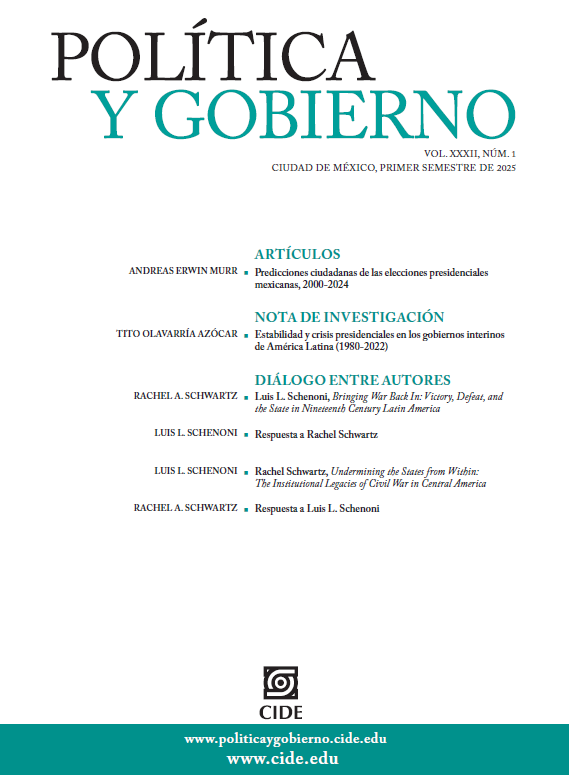
Citizen forecasts of Mexican presidential elections, 2000-2024
Keywords:
citizen forecasting, democratic transition, election forecasting, public opinion polls, political socializationAbstract
Scientific election forecasting has a long and growing tradition in established democracies, but it has not made much progress in Latin America. To make progress, we examine citizen forecasts of Mexican presidential elections from 2000 to 2024. We develop novel statistical tools to study whether citizen forecasts are better at forecasting than chance and than vote intention polls. Using 55 surveys, we find that citizens became better over time. While they forecasted who wins worse than chance at the dawn of democracy in 2000, they forecasted recent presidential elections correctly and are now on par with vote intention polls. While citizens are also better than chance at forecasting vote shares, they remain, however, worse than vote intention polls. To understand why, we analyze the bias and variance of citizen forecasts for the first time. We find that the main reasons for their worse performance are socialization under a one-party rule, inexperience with free-and-fair elections, and unwarranted concerns about the cleanliness of the elections.
Downloads
Published
Issue
Section
License
The authors who publish in this journal agree on the following conditions:
In accordance with copyright laws, Política y gobierno recognizes and respects the authors’ moral rights, as well as the ownership of property rights, which will be transferred to the journal for its dissemination in open access. Política y gobierno does not charge the authors for submitting and processing articles for publication.
All the articles published in Política y gobierno —with no exception— are distributed under a Creative Commons License 4.0 Attribution Non-Commercial (CC BY-NC 4.0 International), that allows third parties to use the published work providing they mention the authorship of the work and the first publication in this journal.
The authors can enter into other independent and additional contractual arrangements for the non-exclusive distribution of the version of the article published in Política y gobierno (for example to include it into an institutional repository or publish it in a book) as lomg as it is clearly indicated that the work was published for the first time in Política y gobierno.
For all of the above, the author(s) must submit the Format of transfer of the ownership of the first publishing rights duly filled in and signed by the author(s). This format can be sent as a pdf by e-mail: politicaygobierno@cide.edu (Letter- transfer of property rights)

This work is licensed under a Creative Commons Attribution-Noncommercial 4.0 International.






 Contact