
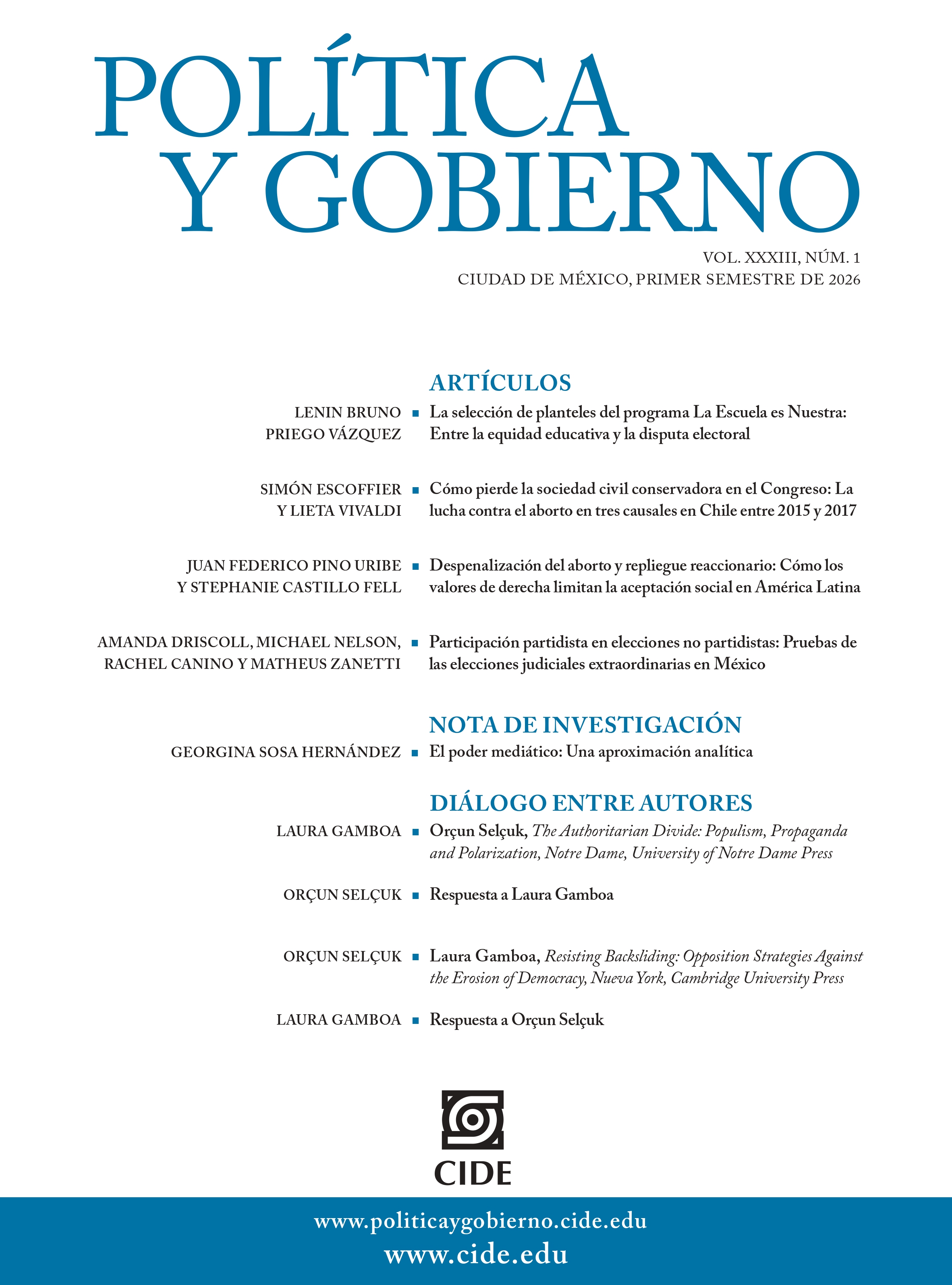
Abortion Decriminalization and Reactionary Retrenchment: How Right-Wing Values Limit Social Acceptance in Latin America
Keywords:
abortion, conservatism, reactionary retenchment, reactionary retrenchmentAbstract
This study examines the relationship between the decriminalization of abortion and its social acceptance, assessing how right-wing values moderate this association. Using multilevel ordered logit models and an original ordinal taxonomy of legal accessibility —comprising absolute prohibition, therapeutic exception, access by specific grounds, and free access—, the analysis compares the cases of Ecuador, Colombia, Uruguay, Peru, Mexico, Chile, and Brazil. Findings show that free access is associated with higher levels of social acceptance, while exception-based re gimes continue to frame abortion as a stigmatized practice. This positive association weakens in the presence of right-wing ideological dispositions —such as exclusionary nationalism, devotional religiosity, and doctrinal exclusivism— which activate a form of reactionary retrenchment: a symbolic containment mechanism that neutralizes the normative potential of legal reform. The study concludes that the social acceptance of abortion is not determined solely by legal frameworks, but also by the ideological disputes that shape and moderate public attitudes toward reproductive rights.
Downloads
Published
Issue
Section
License
The authors who publish in this journal agree on the following conditions:
In accordance with copyright laws, Política y gobierno recognizes and respects the authors’ moral rights, as well as the ownership of property rights, which will be transferred to the journal for its dissemination in open access. Política y gobierno does not charge the authors for submitting and processing articles for publication.
All the articles published in Política y gobierno —with no exception— are distributed under a Creative Commons License 4.0 Attribution Non-Commercial (CC BY-NC 4.0 International), that allows third parties to use the published work providing they mention the authorship of the work and the first publication in this journal.
The authors can enter into other independent and additional contractual arrangements for the non-exclusive distribution of the version of the article published in Política y gobierno (for example to include it into an institutional repository or publish it in a book) as lomg as it is clearly indicated that the work was published for the first time in Política y gobierno.
For all of the above, the author(s) must submit the Format of transfer of the ownership of the first publishing rights duly filled in and signed by the author(s). This format can be sent as a pdf by e-mail: politicaygobierno@cide.edu (Letter- transfer of property rights)

This work is licensed under a Creative Commons Attribution-Noncommercial 4.0 International.






 Contact