
Governments without Majority in Mexico: 1997-2006
Keywords:
divided government, coalitions, party disciplineAbstract
As a contribution to the study of Congress in Mexico, this article focuses onthe legislative task from four indicators: the origin of the initiatives, their adoption rate,the voting patterns on the Chamber of Deputies floor and the coalitions formed in theinitiatives adoption process. The period under review covers the three experiences ofdivided government without a majority, ranging from September 1997 to August 2006(LVII, LVIII and LIX legislatures), and presents the results of the investigation initiated in1997 when it was introduced, for the first time in Mexico, the phenomenon of dividedgovernment. Based on the construction and analysis of a database of all roll-call votes presented inthe Chamber of Deputies floor (1997-2006), the article shows that the perception of anunproductive and systematic opposition to the Executive initiatives in Congress has noempirical basis. It thus refutes the thesis that the Congress plurality has resulted in theinability to reach agreements and that the absence of majorities for the president partyhas led to deadlock or to legislative ungovernability.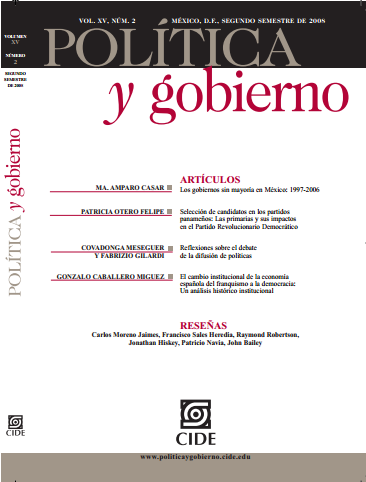
Downloads
Issue
Section
License
The authors who publish in this journal agree on the following conditions:
In accordance with copyright laws, Política y gobierno recognizes and respects the authors’ moral rights, as well as the ownership of property rights, which will be transferred to the journal for its dissemination in open access. Política y gobierno does not charge the authors for submitting and processing articles for publication.
All the articles published in Política y gobierno —with no exception— are distributed under a Creative Commons License 4.0 Attribution Non-Commercial (CC BY-NC 4.0 International), that allows third parties to use the published work providing they mention the authorship of the work and the first publication in this journal.
The authors can enter into other independent and additional contractual arrangements for the non-exclusive distribution of the version of the article published in Política y gobierno (for example to include it into an institutional repository or publish it in a book) as lomg as it is clearly indicated that the work was published for the first time in Política y gobierno.
For all of the above, the author(s) must submit the Format of transfer of the ownership of the first publishing rights duly filled in and signed by the author(s). This format can be sent as a pdf by e-mail: politicaygobierno@cide.edu (Letter- transfer of property rights)

This work is licensed under a Creative Commons Attribution-Noncommercial 4.0 International.






 Contact