
La relación recíproca entre la participación ciudadana y la rendición de cuentas: la experiencia de los Fondos Municipales en el México rural
Keywords:
electoral governance, fraude electoral, reforma electoral, democratización, Costa RicaAbstract
In Costa Rica, parties gradually transformed a fraud-ridden political system into one renowned for its stability and fair elections by the mid-twentieth century. The authors draw unpon a unique database of more than 1300 acusations of ballot-rigging to show that, independently of social structural constraints, parties denounced fraud where electoral laws made the struggle for power more competitive. They also explain how institutional arrangemente generated opportunities for several executuives to assemble legislative coalitions to enacto far-reaching reforms. This paper also argues that nonpartisan commisions should run elections; it explains why splitting responsability over election affaris between the executive and legislature, as classical constitutional theory suggests, is recipe for pastisan rencor and political conflict.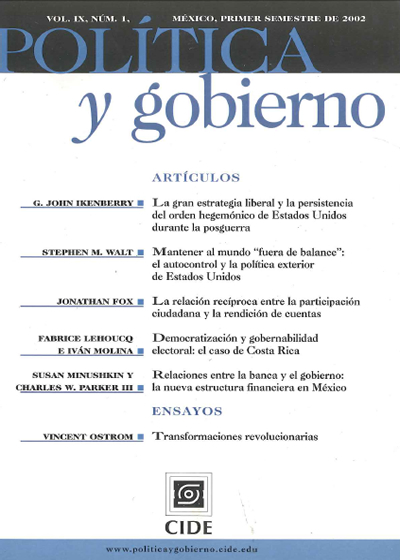
Downloads
Issue
Section
License
The authors who publish in this journal agree on the following conditions:
In accordance with copyright laws, Política y gobierno recognizes and respects the authors’ moral rights, as well as the ownership of property rights, which will be transferred to the journal for its dissemination in open access. Política y gobierno does not charge the authors for submitting and processing articles for publication.
All the articles published in Política y gobierno —with no exception— are distributed under a Creative Commons License 4.0 Attribution Non-Commercial (CC BY-NC 4.0 International), that allows third parties to use the published work providing they mention the authorship of the work and the first publication in this journal.
The authors can enter into other independent and additional contractual arrangements for the non-exclusive distribution of the version of the article published in Política y gobierno (for example to include it into an institutional repository or publish it in a book) as lomg as it is clearly indicated that the work was published for the first time in Política y gobierno.
For all of the above, the author(s) must submit the Format of transfer of the ownership of the first publishing rights duly filled in and signed by the author(s). This format can be sent as a pdf by e-mail: politicaygobierno@cide.edu (Letter- transfer of property rights)

This work is licensed under a Creative Commons Attribution-Noncommercial 4.0 International.






 Contact