
Supreme Court and Constitutional Theory
Abstract
Through out the twentieth century, different forms of organization, integration and faculties were established for the Supreme Court in Mxico. Each one of them was determined by the ongoing political conditions, from the liberal ideas of Carranza to Obregn's personal forms of domination, to Crdenas' ideas within his revolutionary impulse, to the search of ways to fight the backwardness of the Court, and in the recent past, to the establishment of the so called Constitutional Tribunal. Each of the forms mentioned above had a specific rationality that sought to be presented as constitutional thaory, and every change provoked, besides the evident normative transformations, new kinds of understanding of the judicial function.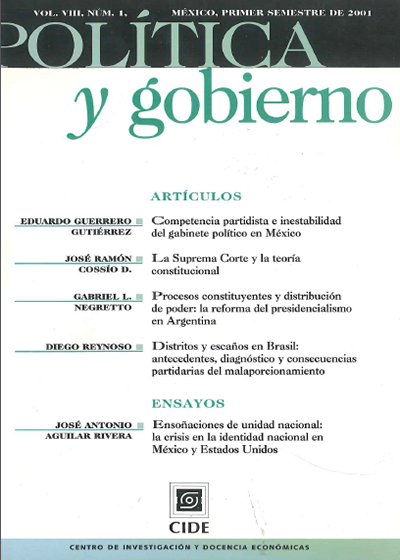
Downloads
Issue
Section
License
The authors who publish in this journal agree on the following conditions:
In accordance with copyright laws, Política y gobierno recognizes and respects the authors’ moral rights, as well as the ownership of property rights, which will be transferred to the journal for its dissemination in open access. Política y gobierno does not charge the authors for submitting and processing articles for publication.
All the articles published in Política y gobierno —with no exception— are distributed under a Creative Commons License 4.0 Attribution Non-Commercial (CC BY-NC 4.0 International), that allows third parties to use the published work providing they mention the authorship of the work and the first publication in this journal.
The authors can enter into other independent and additional contractual arrangements for the non-exclusive distribution of the version of the article published in Política y gobierno (for example to include it into an institutional repository or publish it in a book) as lomg as it is clearly indicated that the work was published for the first time in Política y gobierno.
For all of the above, the author(s) must submit the Format of transfer of the ownership of the first publishing rights duly filled in and signed by the author(s). This format can be sent as a pdf by e-mail: politicaygobierno@cide.edu (Letter- transfer of property rights)

This work is licensed under a Creative Commons Attribution-Noncommercial 4.0 International.






 Contact