
Flujos de capital, tipos de cambio fijos y supervivencia política: México y Argentina, 1994-1995
Abstract
Rising world interest rates and declining investor confidence in both Mexico and Argentina threatened the survival of fixed exchange rates in each of these countries during 1994 and 1995. Facing these common pressures, Mexico was unable to protect its fixed-rule exchange rate regime, yet Argentina successfully preserved its fixed rate of exchange. Why this difference? This paper argues that explanations based on electoral cycles, timing, and economic fundamentals are illuminating but insufficient to explain the differing capacity of the Mexican and Argentine governments to preserve their fixed exchange rates. A more complete explanation is instead found in the divergent structures of the electoral coalitions backing each government and the electoral environment within which each operated. This finding implies that fixed rates of exchange will be sustainable politically, particularly in democratic or democratizing settings, only under very particular circumstances.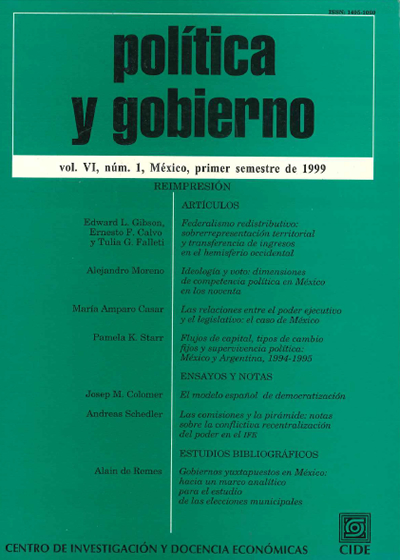
Downloads
Issue
Section
License
The authors who publish in this journal agree on the following conditions:
In accordance with copyright laws, Política y gobierno recognizes and respects the authors’ moral rights, as well as the ownership of property rights, which will be transferred to the journal for its dissemination in open access. Política y gobierno does not charge the authors for submitting and processing articles for publication.
All the articles published in Política y gobierno —with no exception— are distributed under a Creative Commons License 4.0 Attribution Non-Commercial (CC BY-NC 4.0 International), that allows third parties to use the published work providing they mention the authorship of the work and the first publication in this journal.
The authors can enter into other independent and additional contractual arrangements for the non-exclusive distribution of the version of the article published in Política y gobierno (for example to include it into an institutional repository or publish it in a book) as lomg as it is clearly indicated that the work was published for the first time in Política y gobierno.
For all of the above, the author(s) must submit the Format of transfer of the ownership of the first publishing rights duly filled in and signed by the author(s). This format can be sent as a pdf by e-mail: politicaygobierno@cide.edu (Letter- transfer of property rights)

This work is licensed under a Creative Commons Attribution-Noncommercial 4.0 International.






 Contact