
El modelo español de democratización
Abstract
The Spanish model of transition from authoritarianism was constructed on a base of negotiation and a pact between political elites to establish a democratic regime with a wide-ranging social consensus. In contrast with other histories of regime change, violence, retaliation and vengeance were ruled out. This strategy of negotiation and pact is rational when the balance of forces between the ruling and opposition elites produces uncertainty regarding the resulting winners and losers. For each one of the actors, choosing the strategy of confrontation involves the risk of ending up as an absolute loser. Each side must also consider the high costs associated with a destructive confrontation. Because of the fear of instability and conflict, the democratic institutions that were established in Spain during the transition at the end of the 1970s have emphasized government stability. Paradoxically, this has given way to polarization and concentration of power in contrast with the pluralist consensus that surrounded the transition.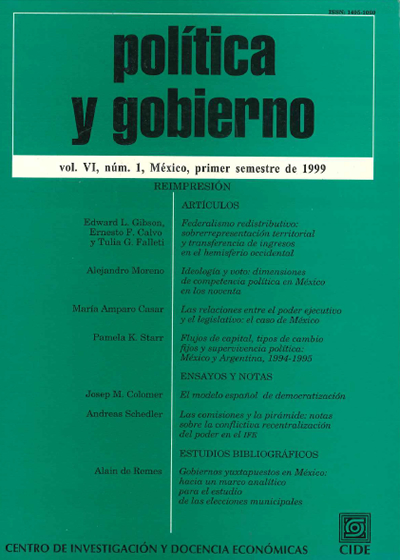
Downloads
Issue
Section
License
The authors who publish in this journal agree on the following conditions:
In accordance with copyright laws, Política y gobierno recognizes and respects the authors’ moral rights, as well as the ownership of property rights, which will be transferred to the journal for its dissemination in open access. Política y gobierno does not charge the authors for submitting and processing articles for publication.
All the articles published in Política y gobierno —with no exception— are distributed under a Creative Commons License 4.0 Attribution Non-Commercial (CC BY-NC 4.0 International), that allows third parties to use the published work providing they mention the authorship of the work and the first publication in this journal.
The authors can enter into other independent and additional contractual arrangements for the non-exclusive distribution of the version of the article published in Política y gobierno (for example to include it into an institutional repository or publish it in a book) as lomg as it is clearly indicated that the work was published for the first time in Política y gobierno.
For all of the above, the author(s) must submit the Format of transfer of the ownership of the first publishing rights duly filled in and signed by the author(s). This format can be sent as a pdf by e-mail: politicaygobierno@cide.edu (Letter- transfer of property rights)

This work is licensed under a Creative Commons Attribution-Noncommercial 4.0 International.






 Contact