
El lanzamiento político de las reformas estructurales en América Latina
Abstract
The economic adjustment and structural reform programsadopted by the emerging democracias of Latin America have questio-ned the prevailing thesis in the 1970s that related the capacity toundertake long-term political changes with authoritarism. Recentexperiences suggests that the new elite's ability to perform changesin economic policies has to do with two factors: the depth of the crisisthese reforms responded to, and the president's capacity to movilzelegislativa majorities through the control of his own party orthrough agreements with other political forces. From the study of fourcases - Bolivia, Argentina, Brazil and Mexico -, this article arguesthat the economic emergency in which the adiustment programs wereformulated, as well as the presidential nature of Latin Americanregimes brought about a decision-making style, strongly based on theexecutive and on his discretional powers. Nevertheless, this decision-making modality does not constitute a new phenomenon; rather, it ispart of an institutional heritage, much more persitent than thegovemmental policies and programs.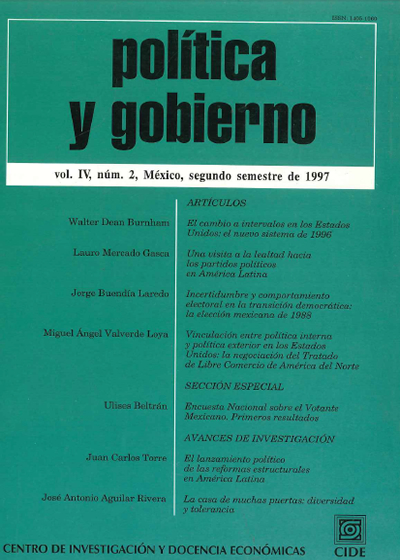
Downloads
Issue
Section
License
The authors who publish in this journal agree on the following conditions:
In accordance with copyright laws, Política y gobierno recognizes and respects the authors’ moral rights, as well as the ownership of property rights, which will be transferred to the journal for its dissemination in open access. Política y gobierno does not charge the authors for submitting and processing articles for publication.
All the articles published in Política y gobierno —with no exception— are distributed under a Creative Commons License 4.0 Attribution Non-Commercial (CC BY-NC 4.0 International), that allows third parties to use the published work providing they mention the authorship of the work and the first publication in this journal.
The authors can enter into other independent and additional contractual arrangements for the non-exclusive distribution of the version of the article published in Política y gobierno (for example to include it into an institutional repository or publish it in a book) as lomg as it is clearly indicated that the work was published for the first time in Política y gobierno.
For all of the above, the author(s) must submit the Format of transfer of the ownership of the first publishing rights duly filled in and signed by the author(s). This format can be sent as a pdf by e-mail: politicaygobierno@cide.edu (Letter- transfer of property rights)

This work is licensed under a Creative Commons Attribution-Noncommercial 4.0 International.






 Contact