
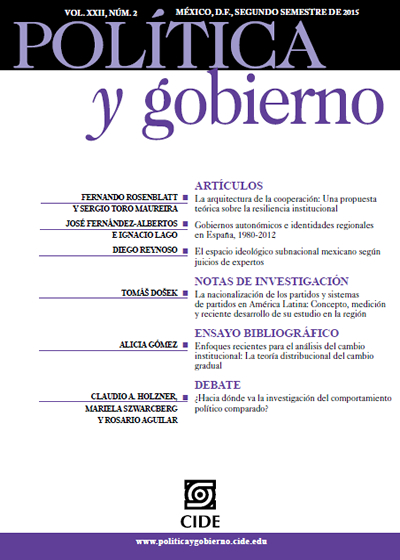
Mexican Subnational Ideological Space as Expert Opinions
Keywords:
political ideolog, subnational politics, Mexican states, left-right dimension, scaling methods, bridging observationsAbstract
This article identifies the ideological position of political parties, governors, and candidates across Mexican states along the ideological left-right dimension. The article locates political actors’s ideology on the same ideological space using a survey of experts, which includes bridging observations, and a scaling methodology. This methodology allows to make systematic and robust comparisons of ideological positions of political parties across all Mexican states, as well as estimating the degree of polarization in gubernatorial races and the ideological distance between incumbent governments and challenger candidates.References
Alcántara, Manuel (dir.) (1994-2008), Boletín Datos de Opinión, núm. 16. Proyecto de Élites Parlamentarias Latinoamericanas, Universidad de Salamanca.
Alcántara, Manuel (2004), ¿Instituciones o máquinas ideológicas? Origen, programa y organización de los partidos latinoamericanos, Barcelona, Institut de Ciències Polítiques i Socials (icps).
(2008), “La escala de la izquierda”, Nueva Sociedad, 217, pp. 72-85.
Alcántara, Manuel y Cristina Rivas (2007), “Las dimensiones de la polarización partidista en América Latina”, Política y Gobierno, XIV(2), pp. 349-390.
Aldrich, John y Richard McKelvey (1977), “A Method of Scaling with Applications to the1968 and 1972 Presidential Elections”, The American Political Science Review, 71(1), pp. 111-130.
Ameringer, Charles (1992), Political Parties of the Americas, 1980 to 1990: Canada,Latin America, and the West Indies, Westport, Greenwood Press.
Bakker, Ryan, Seth Jolly, Jon Polk y Keith Poole (2014), “The European Common Space: Extending the Use of Anchoring Vignettes”, Journal of Politics, 76(4), pp. 1089-1101.
Bobbio, Norberto (1995), Derecha e izquierda: Razones y significados de una distinción política, Madrid, Taurus.
Cantú, Francisco, Scott Desposato y Eric Magar (2014), “Consideraciones metodológicas para estudiantes de política legislativa mexicana: Sesgo por selección en votaciones nominales”, Política y Gobierno, XXI(1), pp. 25-54.
Castles, Francis y Peter Mair (1984), “Left-Right Political Scales: Some Expert Judgements”, European Journal of Political Research, 12, pp. 73-88.
Colomer, Josep y Luis Escatel (2005), “La dimensión izquierda-derecha en América Latina”, Desarrollo Económico, 45(177), pp. 123-136.
Coppedge, Michael (1998), “The Dynamic Diversity of Latin American Party Systems”, Party Politics, 4(4), pp. 547-568.
(2007), “Continuity and Change in Latin America Party Systems”, Taiwan Journal of Democracy, 3(2), pp. 119-149.
Dominguez, Jorge I. y James McCann (1996), Democratizing Mexico: Public Opinion and Electoral Choices, Baltimore, The Johns Hopkins University Press.
Dominguez, Jorge I. y James McCann (1998), “Mexicans React to Electoral Fraud and Political Corruption: An Assessment of Public Opinion and Voting Behavior”, Electoral Studies, 17(4), pp. 483-503.
Downs, Anthony (1957), An Economic Theory of Democracy, Nueva York, Harper and Row.
Enelow, James y Melvin Hinich (1984), The Spatial Theory of Voting: An Introduction, Cambridge, Cambridge University Press.
Espinoza, Orlando (2011), “Arenas de fortuna y virtud: La alternancia política de los gobernadores en los estados mexicanos, 1989-2006”, tesis doctoral, Flacso México.
Gervasoni, Carlos (2011), “Democracia, autoritarismo e hibridez en las provincias argentinas: La medición y causas de los regímenes subnacionales”, Journal of Democracy en español, 3, pp. 75-93.
Gramacho, Wladimir e Iván Llamazares (2007), “Ideología y preferencia de intervención económica estatal entre los diputados latinoamericanos”, Documentos cidob 18, Barcelona.
Heller, Agnes y Ferenc Fehér (1985), Anatomía de la izquierda occidental, Barcelona, Península.
Huber, John y Ronald Inglehart (1995), “Expert Interpretation of Party Space and Party Locations in 42 Societies”, Party Politics, 1(1), pp. 73-111.
Jones, Mark (2005), “The Role of Parties and Party Systems in the Policymaking Process”, documento preparado para el Workshop State Reform, Public Policies, and Policymaking Process, Inter-American Development Bank, Washington, 28 de febrero a 2 de marzo, pp. 1-74.
King, Gary, Christopher J.L. Murray, Joshua A. Salomon y Ajay Tandon (2003), “Enhancing the Validity and Cross-cultural Comparability ofMeasurement in Survey Research”, American Political Science Review, 97(4), pp. 557-583.
Kitschelt, Herbert (2001), “Party and Party System Dynamics in Latin America: An Inductive Comparative Exploration Prompted by the Salamanca1997-1998 Politicians’ survey”, trabajo presentado en el Seminario de Investigación del Área de Ciencia Política, Universidad de Salamanca.
Kitschelt, Herbert, Kirk Hawkings, Juan Pablo Luna, Guillermo Rosas y Elizabeth Zechmeister (2010), Latin American Party Systems, Nueva York, Cambridge University Press.
Klesner, Josep (2004), “The Structure of Mexican Electorate: Social, Attitudinal, and Partisan Bases of Vicente Fox’s Victory”, en Jorge I. Dominguez y Lawson Chappell (eds.), Mexico’s Pivotal Democratic Elections, Candidates, Voters, and the Presidential Campaign of 2000, Stanford, StanfordUniversity Press.
Langston, Joy y Alberto Díaz-Cayeros (2003), “The Consequences of Competition: Gubernatorial Nominations in Mexico, 1994-2000”, documento de trabajo 160, México, cide, División de Estudios Políticos.
Laver, Michael y Ben Hunt (1992), Policy and Party Competition, Nueva York, Routledge, Lhapman and Hall. Llamazares, Iván y Rick Sandell (2003), “Partidos políticos y dimensiones ideológicas en Argentina, Chile, México y Uruguay”, Polis: Investigación y Análisis Sociopolítico y Psicosocial, 0(99), pp. 43-69.
Loza, Nicolás y Álvaro López Lara (2003), “Viejos actores, nuevo poder: Los diputados locales en México”, Polis 1(3), pp. 49-84.
Loza, Nicolás e Irma Méndez Hoyos (2013), “De la calidad de las elecciones a la calidad de las democracias en los estados mexicanos, 2001-2012”, Revista Mexicana de Derecho Electoral, 4, pp. 353-368.
Loza, Nicolás e Irma Méndez (coords.) (2013), Evaluación de expertos en política estatal en México, 2002-2012 (Eepemex), México, Flacso/pnud/Conacyt.
Luna, Juan Pablo y Elizabeth Zechmeister (2005), “Political Representation in Latin America: A Study of Elite-mass Congruence in Nine Countries”, Comparative Political Studies, 38, pp. 388-441.
Magaloni, Beatriz (1996), “Dominio de partido y dilemas duvergerianos en las elecciones presidenciales de 1994 en México”, Política y Gobierno,III(2), pp. 281-326.
Mainwaring, Scott y Mariano Torcal (2005), “La institucionalización del sistema partidistas después de la tercera ola de democratización”, AméricaLatina Hoy, 41, pp. 141-173.
Mainwaring, Scott y Timothy Scully (1995), Building Democratic Institutions, Stanford, Stanford University Press.
McDonald, Ronald y J. Mark Ruhl (1989), Party Politics and Elections in Latin America, Boulder, Westview Press.
Molinar Horcasitas, Juan (1991), El tiempo de la legitimidad, México, Cal y Arena.
Moreno, Alejandro (1999), “Ideología y voto: Dimensiones de la competencia política en México en los noventa”, Política y Gobierno, VI(1), pp. 45-81.
Palfrey, Thomas y Keith Poole (1987), “The Relationship between Information, Ideology and Voting Behavior”, American Journal of PoliticalScience, 31(3), pp. 511-530.
Poole, Keith (1998), “Recovering a Basic Space from a Set of Issue Scales”, American Journal of Political Science, 42 (3), pp. 954-993.
Poole, Keith, Howard Rossenthal, Jeffrey Lewis, James Lo y Royce Carroll (2013), Basicspace: A Package to Recover a Basic Space from Issue Scales, disponible en: http://CRAN.R-project.org/package=basicspace [fechade consulta: 30 de mayo de 2014].
Poole, Keith, Christopher Hare, David A. Armstrong, Ryan Bakker y Royce Carroll (2014), “Using Bayesian Aldrich-McKelvey Scaling to Study Citizens’ Ideological Preferences and Perceptions”, American Journal of Political Science ( en línea).
Reynoso, Diego (2011), La estrategia dominante: Alianzas electorales en los estados mexicanos, Buenos Aires, Teseo.
Rivas Pérez, Cristina (2006), “Las dimensiones de la polarización en los parlamentos”, en Manuel Alcántara (ed.), Políticas y políticos en América Latina, Madrid, Siglo XXI, pp. 215-254.
Rosas, Guillermo y Joy Langston (2011), “Gubernatorial Effects in the Voting Behavior of National Legislators”, The Journal of Politics, 73(2), pp. 477-493.
Ruiz Rodríguez, Leticia (2006), “Coherencia partidista: La estructuración interna de los partidos políticos en América Latina”, Revista Española deCiencia Política, 14, abril, pp. 87-114.
Saiegh, Sebastian (2009), “Recovering a Basic Space from Elite Surveys: Evidence from Latin America”, documento inédito, ucsd.
(2015), “Using Joint Scaling Methods to Study Ideology and Representation: Evidence from Latin America”, Political Analysis, pp. 1-22.
Sani, Giacomo y Giovanni Sartori (1983), “Polarization, Fragmentation and Competition in Western Democracies”, en Hans Daalder y Peter Mair, Western European Party Systems, Beverly Hills, Sage.
Sartori, Giovani (1976), Partidos y sistemas de partido, México, Alianza.
Selios, Lucía (2009), “Distinción ideológica en las élites latinoamericanas”, Boletín Datos de Opinión, núm. 13-09, Proyecto de Élites Parlamentarias Latinoamericanas, Universidad de Salamanca.
Sohr, Boris y Nolan McCarty (2011), “The Ideological Mapping of American Legislatures”, American Political Science Review, 105(3), pp. 530-551.
Tsebelis, George (2002), Veto Players. How Political Institutions Work, Princeton, Princeton University Press.
Wiesehomeier, Nina y David Doyle (2012), “Attitudes, Ideological Associations and the Left-Right Divide in Latin America”, Journal of Politicsin Latin America, 3(1), pp. 3-33.
Zechmeister, Elizabeth (2006), “Qué es la izquierda y quién está a la derecha en la política mexicana: Un enfoque con el método Q al estudio de las etiquetas ideológicas”, Política y Gobierno, XIII(1), pp. 51-98.
Downloads
Issue
Section
License
The authors who publish in this journal agree on the following conditions:
In accordance with copyright laws, Política y gobierno recognizes and respects the authors’ moral rights, as well as the ownership of property rights, which will be transferred to the journal for its dissemination in open access. Política y gobierno does not charge the authors for submitting and processing articles for publication.
All the articles published in Política y gobierno —with no exception— are distributed under a Creative Commons License 4.0 Attribution Non-Commercial (CC BY-NC 4.0 International), that allows third parties to use the published work providing they mention the authorship of the work and the first publication in this journal.
The authors can enter into other independent and additional contractual arrangements for the non-exclusive distribution of the version of the article published in Política y gobierno (for example to include it into an institutional repository or publish it in a book) as lomg as it is clearly indicated that the work was published for the first time in Política y gobierno.
For all of the above, the author(s) must submit the Format of transfer of the ownership of the first publishing rights duly filled in and signed by the author(s). This format can be sent as a pdf by e-mail: politicaygobierno@cide.edu (Letter- transfer of property rights)

This work is licensed under a Creative Commons Attribution-Noncommercial 4.0 International.






 Contact