
Army as Police? Correlates of Public Confidence in the Police, Justice System, and the Military: México in Comparative Context
Keywords:
México, army, police, organized crime, human rights violations, government's security forcesAbstract
Typical responses to the perceived escalation of violent crime throughout most of Latín América are to increase the size and powers of the regular police and —in most cases— to expand the involvement by the armed forces to confront both common and organized crime. Participation by the armed forces in domestic policing, in turn, has
sparked debates in several countries about the serious risks incurred, especially with respect to human risks violations. in México the debate is sharpened by the extensive violence linked to conflicts among drug-trafficking organizations and between these and the govemment's security forces. in which the Army and Navy have played leading roles. Using Word Values Survey and Americas Barometer data, we examine trends in public confidence in the police, justice system, and armed forces in México over 1990-2010. Using Vanderbilt University's 2010 LAPOP survey we compare Levels of trust in various social, political, and governments actors, locating México in the broader Latin America
context. That survey also poses questions about the appropriateness of the military acting as domestic police in fighting crime. Here we ask: Is public support for using the military as police widespread and generalized across the sample? Or are there patterns of support and opposition with respect to public opinion.' Our main findings are that 1) the armed forces rank at the top regarding trust, and —while trust in other Mexican Institutions tended to decline in 2008-2010— trust in the military increased slightly; 2) respondents indicate that the military respects human rights more than the average and substantially more than the police or government generally ;3) public support for the military in fighting crime is strong and distributed evenly across the ideological spectrum and across socio-demographic groups, and 4) patterns of support emerge more clearly with respect to perceptions, attitudes, and performance judgments. By way of conclusion we consider some of the political and policy implications of our findings.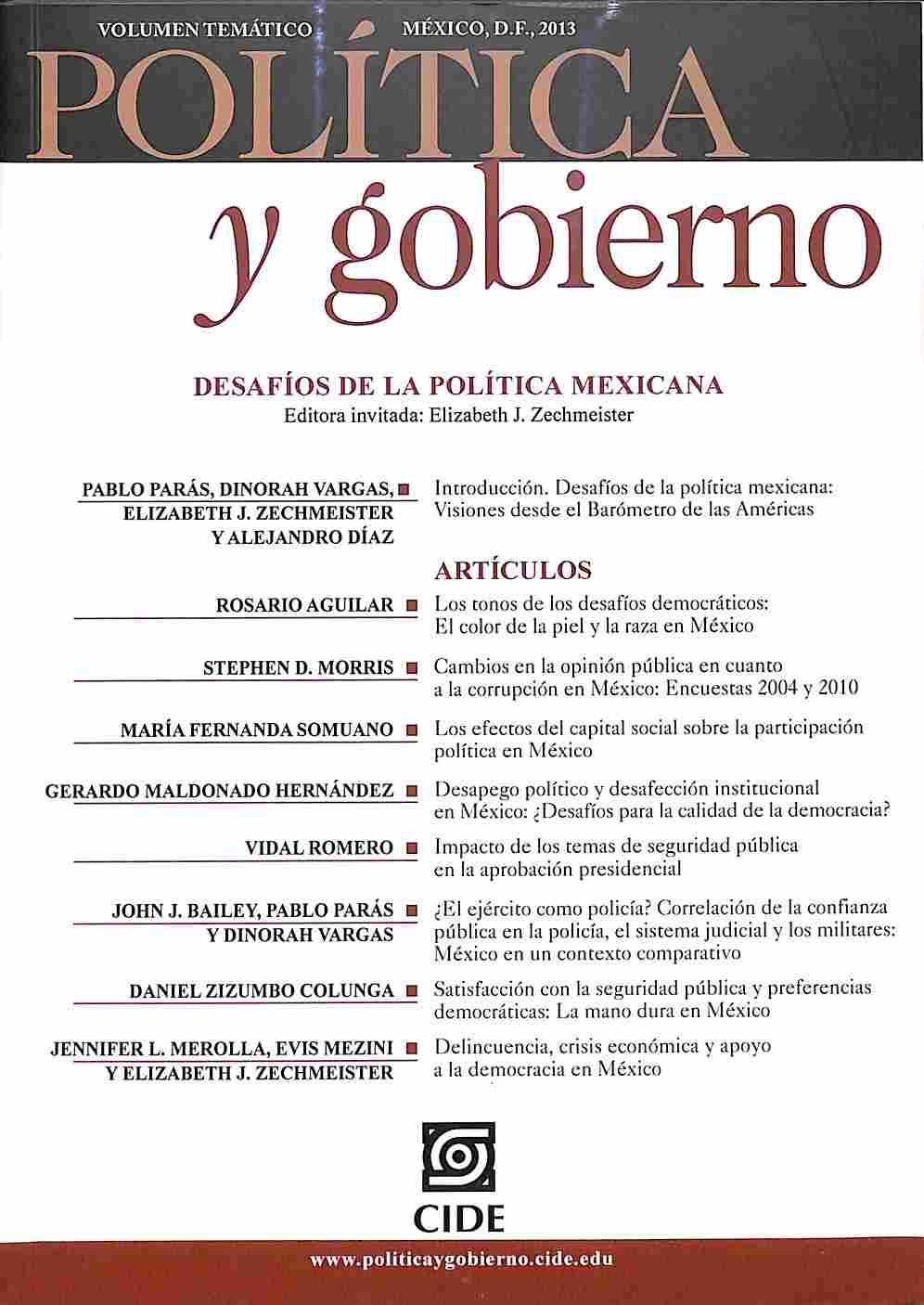
Downloads
Published
Issue
Section
License
The authors who publish in this journal agree on the following conditions:
In accordance with copyright laws, Política y gobierno recognizes and respects the authors’ moral rights, as well as the ownership of property rights, which will be transferred to the journal for its dissemination in open access. Política y gobierno does not charge the authors for submitting and processing articles for publication.
All the articles published in Política y gobierno —with no exception— are distributed under a Creative Commons License 4.0 Attribution Non-Commercial (CC BY-NC 4.0 International), that allows third parties to use the published work providing they mention the authorship of the work and the first publication in this journal.
The authors can enter into other independent and additional contractual arrangements for the non-exclusive distribution of the version of the article published in Política y gobierno (for example to include it into an institutional repository or publish it in a book) as lomg as it is clearly indicated that the work was published for the first time in Política y gobierno.
For all of the above, the author(s) must submit the Format of transfer of the ownership of the first publishing rights duly filled in and signed by the author(s). This format can be sent as a pdf by e-mail: politicaygobierno@cide.edu (Letter- transfer of property rights)

This work is licensed under a Creative Commons Attribution-Noncommercial 4.0 International.






 Contact