
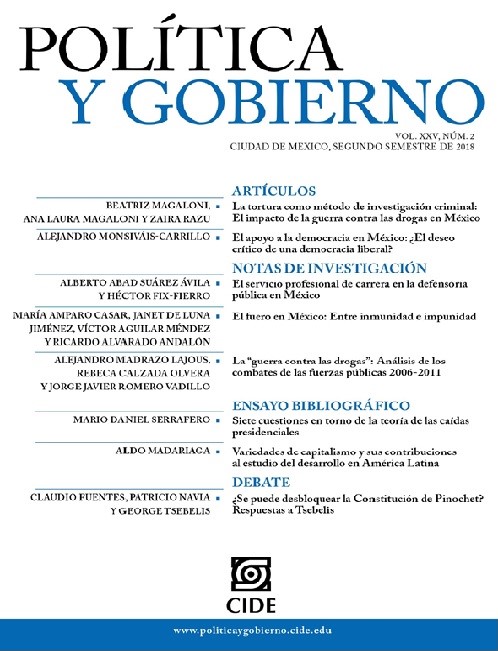
Debate constitucional en Chile ¿Reemplazo vía enmienda?/Constitutional Debate in Chile: Replacement through Amendment?
Keywords:
cambio constitucional, Constitución de 1980, Chile, sistema político, teoría constitucionalAbstract
En este artículo se discute el argumento desarrollado por George Tsebelis (2018), quien propone un modelo para entender el reemplazo constitucional en Chile. Se sostiene que ese modelo funciona de mejor modo para explicar ciclos de reforma que propiamente de reemplazo. Tal como algunos autores han indicado, se señala que existirían ciertas condiciones políticas exógenas a las normas constitucionales que posibilitarían una transformación sustantiva y son aquellas condiciones las que están ausentes en el caso de Chile. Así, el trabajo de Tsebelis analíticamente nos permitiría modelar el espacio de decisiones en un contexto donde los actores tienen incentivos predefinidos y las reglas del juego son relativamente constantes. Para responder a la pregunta de por qué los actores políticos muestran disposición a cambiar el statu quo en un escenario de “normalidad”, se sugieren tres factores: la percepción de los actores de veto de eventuales costos futuros de mantener el statu quo vigente, el juego de poder Ejecutivo-Legislativo, y la politización de la Constitución en la medida en que cambios en la distribución de poder activan reformas que tocan aspectos cruciales de la misma
This article is a response toward George Tsebelis’ argument (2018) concerning the incentives for constitutional replacement in Chile. It suggests that Tsebelis’ model may work better to explain dynamic of constitutional reforms than dynamic of replacement. As some authors have addressed, this article suggests that there are some crucial exogenous conditions of the constitutional-institutional realm that may influence the possibility of replacing a given constitution and such conditions are not present in the case of Chile. Therefore, Tsebelis’ model may help us to analytically explain the space of decision of actors who may have predefined incentives in a context of a “normal” institutional setting. To respond to the question of why some actors are willing to change the statu quo in a context of pre-fixed incentives, this articles suggest three of them: actors’ perception of the future costs of maintaining the statu quo, the game of power between the Executive and the Legislative, and changes in the balance of power triggering the need for change of crucial aspects of the Constitution
Downloads
Published
Issue
Section
License
The authors who publish in this journal agree on the following conditions:
In accordance with copyright laws, Política y gobierno recognizes and respects the authors’ moral rights, as well as the ownership of property rights, which will be transferred to the journal for its dissemination in open access. Política y gobierno does not charge the authors for submitting and processing articles for publication.
All the articles published in Política y gobierno —with no exception— are distributed under a Creative Commons License 4.0 Attribution Non-Commercial (CC BY-NC 4.0 International), that allows third parties to use the published work providing they mention the authorship of the work and the first publication in this journal.
The authors can enter into other independent and additional contractual arrangements for the non-exclusive distribution of the version of the article published in Política y gobierno (for example to include it into an institutional repository or publish it in a book) as lomg as it is clearly indicated that the work was published for the first time in Política y gobierno.
For all of the above, the author(s) must submit the Format of transfer of the ownership of the first publishing rights duly filled in and signed by the author(s). This format can be sent as a pdf by e-mail: politicaygobierno@cide.edu (Letter- transfer of property rights)

This work is licensed under a Creative Commons Attribution-Noncommercial 4.0 International.






 Contact