
Traditional Media and Social Networks in the 2018 Presidential Election
Keywords:
2018 election, media, media effects, social mediaAbstract
This work seeks to know the relationship between the preferences of the voters and their
consumption of media and attention to advertising during the last presidential election in Mexico.
To do this, statistical models are discussed where the dependent variables are the vote for each
candidate and the change or stability in their preferences, and the independent variables are the
intensity in the use of media, measured through weekly consumption of news about the campaign,
and recall of the political publicity of the candidates. These models do not show a signifcant relationship between media consumption and electoral preferences. Faced with the belief that social
media helped the winning candidate, this study fnds no empirical support for it, in line with the
tradition that fnds that the media has little or no effect on voter preferences.
References
Ansolabehere, Stephen D., Roy Behr y Shanto Iyengar (1993), The Media Game: American Politics in the Television Age, Nueva York: MacMillan.
Bartels, Larry M. (1988), The History of Marketing Thought, 3a. ed., Columbus: Publishing Horizons.
Bartels, Larry (2006), “Priming and Persuasion in Presidential Campaigns”, en Henry E. Brady y Richard Johnston (eds.), Capturing Campaign Effects, Ann Arbor: University of Michigan Press, pp. 78-112.
Baum, Michael A. (2003), Soft News Go to War: Public Opinion and American Foreign Policy in the New Media Age, Princeton: Princeton University Press.
Beltrán, Ulises (2009), “Publicidad y preferencias”, Política y Gobierno, volumen temático “Elecciones en México”, pp. 237-271.
Beltrán, Ulises, Sandra Ley y Rodrigo Castro Cornejo (2020), Encuesta Nacional Electoral (cide-cses) 2018, México: Centro de Investigación y Docencia Económicas.
Bennett, W. Lance y Shanto Iyengar (2008), “A New Era of Minimal Effects? the Changing Foundations of Political Communication”, Journal of Communication, 58(4), pp. 707-731.
Bennett W. Lance y Shanto Iyengar (2010), “The Shifting Foundations of Political Communication: Responding to a Defense of the Media Effects Paradigm”, Journal of Communication, 60(1), pp. 35-39.
Brox, Brian J. y Daron R. Shaw (2006), “Political Parties, American Campaigns, and Effects on Outcomes”, en Richard S Katz y William J. Croty (eds.), Handbook of Party Politics, Thousand Oaks: Sage Publications, pp. 46-159.
Buendía Hegewisch, José y José Manuel Aspiroz Bravo (2011), Medios de comunicación y la reforma electoral 2007-2008: Un balance preliminar, Ciudad de México: Tribunal Electoral del Poder Judicial de la Federación.
Chong, Dennis (1996), “Creating Common Frames of Reference on Political Issues”, en Diana C. Mutz, Paul M. Sniderman y Richard A. Brody (eds.), Political Persuasion and Attitude Change, Ann Arbor: University of Michigan Press.
DOF (Diario Ofcial de la Federación) (2008), Decreto por el que se expide el Código Federal de Instituciones y Procedimientos Electorales, 14 de enero, disponible en: http://dof.gob.mx/nota_detalle.php?codigo=5028346fecha=14/01/2008 [fecha de consulta: 8 de julio de 2020].
Fiske Susan T., Donald R Kinder y W. Michael Larter (1983), “The Novice and the Expert: Knowledge-based Strategies in Political Cognition”, Journal of Experimental Social Psychology, 19(4), pp. 381-400.
INE (Instituto Nacional Electoral) (2017), “Acuerdo del Consejo General del Instituto Nacional Electoral, por el que se establece el periodo de precampañas para el proceso electoral federal 2017-2018, así como diversos criterios y plazos de procedimientos relacionados con las mismas”, 8 de septiembre, disponible en: https://repositoriodocumental.ine.mx/xmlui/bitstream/handle/123456789/93573/CGex201709-08-ap-12.pdf?sequence=1&isAllowed=y [fecha de consulta: 8 de julio de 2020].
INE (Instituto Nacional Electoral) (2018a), “Crónica del Proceso Electoral 2017-2018, junio 2018”, disponible en: https://www.ine.mx/cronica-del-proceso-electoral-2017-2018-junio-2018/ [fecha de consulta: 8 de julio de 2020].
INE (Instituto Nacional Electoral) (2018b), “Numeralia Proceso Electoral 2017-2018”, 8 de junio, disponible en: https://www.ine.mx/numeralia-proceso-electoral-2017-2018/ [fecha de consulta: 8 de julio de 2020].
Iyengar, Shanto y Adam F. Simon (2000), “New Perspectives and Evidence on Political Communication and Campaign Effects”, Annual Review of Psychology, 51, pp. 149-169.
Iyengar, Shanto y Donald R. Kinder (1987), News that Matters: Television and American Opinion, Chicago: University of Chicago Press.
Iyengar, Shanto, Donald R. Kinder, Mark D. Peters y Jon A. Krosnick (1984), “The Evening News and Presidential Evaluations”, Journal of Personality and Social Psychology, 46(4), pp. 778-787.
Katz, Elihu y Paul F. Lazarsfeld (1955), The Part Played by People in the Flow of Mass Communications, Glencoe: The Free Press.
Klapper, Joseph T. (1960), The Effects of Mass Communication, Glencoe: The Free Press.
Krosnick, Jon A. y Donald R. Kinder (1990), “Altering the Foundations of Support for the President Through Priming”, American Political Science Review, 84(2), pp. 497-512.
Manin, Bernard (1997), The Principles of Representative Government, Nueva York: Cambridge University Press.
McCombs, Maxwell (1992), “Explorers and Surveyors: Expanding Strategies for Agenda Setting Research”, Journalism Quarterly, 69(4), pp. 813-824.
McCombs, Maxwell y Donald L. Shaw (1972), “The Agenda Setting Function of Mass Media”, Public Opinion Quarterly, 36(2), pp. 176-187.
McCombs, Maxwell, Donald L. Shaw y David H. Weaver (1997), Communication and Democracy: Exploring the Intellectual Frontiers in Agenda Setting Theory, Hillsdale: Lawrence Erlbaum.
Miller, Joanne M. y Jon A. Krosnick (2000), “News Media Impact on the Ingredients of Presidential Evaluations”, American Journal of Political Science, 44(2), pp. 295-309.
Popkin, Samuel (1994), The Reasoning Voter. Communication and Reasoning in Presidential Campaigns, Chicago: University of Chicago Press.
Rogers Everett y James Dearing (1988), “Agenda-Setting Research: Where has it been and Where is it going?”, en James A. Anderson (ed.), Communication Yearbook, Beverly Hills: Sage Publications.
Sartori, Giovanni (1989), “Video-Power”, Government and Opposition, 24(1), pp. 39-53.
Scheufele, Dietram A. y David Tewksbury (2007), “Framing, Agenda Setting and Priming: The Evolution of Three Media Effects Models”, Journal of Communication”, 57 (1), pp. 9-20.
Vázquez, Rubén (2018), “Las redes sociales durante la jornada electoral”, Forbes México, 2 de julio, disponible en: https://www.forbes.com.mx/las-redes-sociales-durante-la-jornada-electoral/ [fecha de consulta: 8 de julio de 2020].
Zaller, John (1992), The Nature and Origins of Mass Opinion, Cambridge: Cambridge University Press.
Zaller, John (1996), “The Myth of Massive Media Impact Revisited”, en Diana C. Mutz, Paul M. Sniderman y Richard A. Brody (eds.), Political Persuasion and Attitude Change, Ann Arbor: University of Michigan Press.
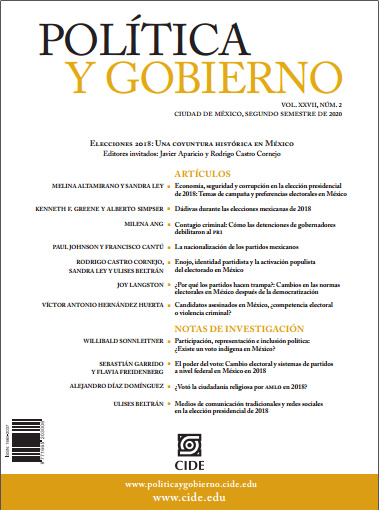
Downloads
Published
Issue
Section
License
The authors who publish in this journal agree on the following conditions:
In accordance with copyright laws, Política y gobierno recognizes and respects the authors’ moral rights, as well as the ownership of property rights, which will be transferred to the journal for its dissemination in open access. Política y gobierno does not charge the authors for submitting and processing articles for publication.
All the articles published in Política y gobierno —with no exception— are distributed under a Creative Commons License 4.0 Attribution Non-Commercial (CC BY-NC 4.0 International), that allows third parties to use the published work providing they mention the authorship of the work and the first publication in this journal.
The authors can enter into other independent and additional contractual arrangements for the non-exclusive distribution of the version of the article published in Política y gobierno (for example to include it into an institutional repository or publish it in a book) as lomg as it is clearly indicated that the work was published for the first time in Política y gobierno.
For all of the above, the author(s) must submit the Format of transfer of the ownership of the first publishing rights duly filled in and signed by the author(s). This format can be sent as a pdf by e-mail: politicaygobierno@cide.edu (Letter- transfer of property rights)

This work is licensed under a Creative Commons Attribution-Noncommercial 4.0 International.






 Contact