
Overcoming Uncertainty: Retrospective Vote in the Mexican Presidential Election
Keywords:
retrospective vote, presidential elections, uncertaintyAbstract
When conditions are bad, citizens vote against the ruling party. This assumption, however,faces a strong challenge in the Mexican political system, where only one party hasheld the presidency for more than 70 years. In this context, a rational voter would be unableto evaluate the consequences of the policies implemented by an opposition party basedon its past performance. In the 1997 national election the incumbent party, the PRI,lost for the first time the majority of the popular vote, in what seemed to be a clear rejectionto the performance of the party in the 1994 crisis. Nevertheless, the PRI also lost thepresidency in July 2000, even though after 1997 most economic indicators showed signs ofimprovement and by December 1999 the PRI topped the polls with more than 50 percentof the voting preferences. Based on two national polls, raised in February and June, 2000,and using the retrospective vote model, this article shows the importance of the retrospectiveevaluations of the situation of the country and the prospective perceptions of the candidatespossible performance on the probability of individuals to vote for the PRI. It alsohiglights the role played by the different levels of certainty about the performance of theopposition on the probability to vote for Vicente Fox.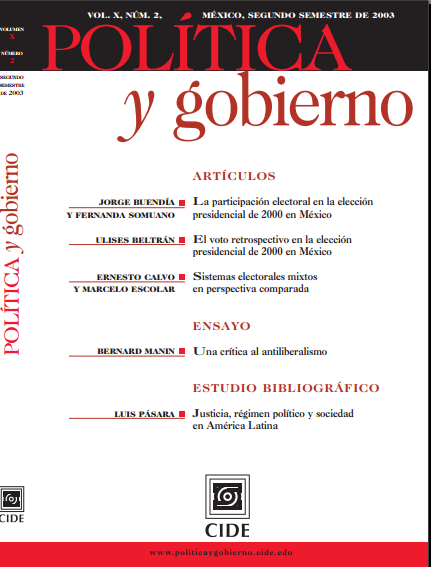
Downloads
Issue
Section
License
The authors who publish in this journal agree on the following conditions:
In accordance with copyright laws, Política y gobierno recognizes and respects the authors’ moral rights, as well as the ownership of property rights, which will be transferred to the journal for its dissemination in open access. Política y gobierno does not charge the authors for submitting and processing articles for publication.
All the articles published in Política y gobierno —with no exception— are distributed under a Creative Commons License 4.0 Attribution Non-Commercial (CC BY-NC 4.0 International), that allows third parties to use the published work providing they mention the authorship of the work and the first publication in this journal.
The authors can enter into other independent and additional contractual arrangements for the non-exclusive distribution of the version of the article published in Política y gobierno (for example to include it into an institutional repository or publish it in a book) as lomg as it is clearly indicated that the work was published for the first time in Política y gobierno.
For all of the above, the author(s) must submit the Format of transfer of the ownership of the first publishing rights duly filled in and signed by the author(s). This format can be sent as a pdf by e-mail: politicaygobierno@cide.edu (Letter- transfer of property rights)

This work is licensed under a Creative Commons Attribution-Noncommercial 4.0 International.






 Contact