
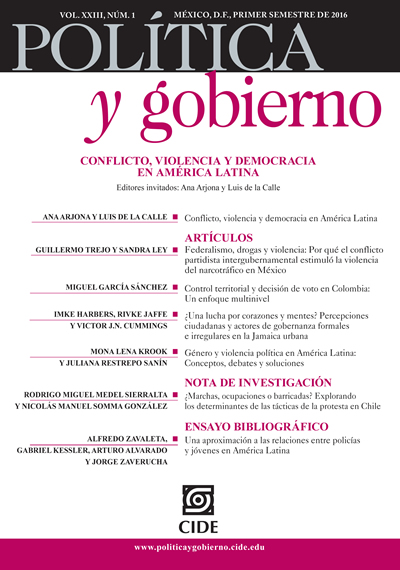
Federalism, drugs, and violence Why intergovernmental partisan conflict stimulated inter-cartel violence in Mexico
Keywords:
federalism, inter-governmental conflict, partisanship, inter-cartel violence, MexicoAbstract
The dominant view of the dramatic increase of criminal violence in Mexico following the 2007 federal intervention in the War on Drugs suggests that inter-cartel violence became particularly intense in subnational regions where the president could not coordinate the federal government’s actions with subnational opposition rulers but came under control where the president worked with his co-partisans. In this article we challenge the “coordination” argument and claim that in contexts of acute political polarization between Left and Right —like the one Mexico experienced before the War on Drugs— partisan conflict can motivate federal authorities to develop cooperative military and policing interventions in regions where the president’s co-partisans rule, but to deliberately neglect effective assistance to the president’s main political rivals and then blame the violence on them. Based on an original dataset of inter-cartel violence in Mexico (2006-2012), we show that while criminal violence was more intense in municipalities from states ruled by opposition parties, it was five times greater in cities ruled by the Left —the president’s political nemesis. We use case studies to show how Mexico’s conservative federal government followed differentiated strategies to deal with spirals of drug violence: it worked together and protected subnational co-partisans (PAN); partially cooperated with centrist opposition authorities (PRI); but confronted leftist governors and mayors (PRD) and left them at the mercy of drug cartels. Our results are consistent with findings in conflict studies showing that state agents do not always seek the monopoly on violence and sometimes tolerate violence to punish their political enemies.References
Acemoglu, Daron, James A. Robinson y Rafael J. Santos (2013), “The Monopoly of Violence: Evidence from Colombia”, Journal of the European Economic Association, 11(1), pp. 5-44.
Aguilar, Rubén y Jorge Castañeda (2009), El narco: La guerra fallida, Mexico, Punto de Lectura.
Animal Político (2011), “Los medios están satanizando a Apatzingán: GenaroGuízar, alcalde”, 5 de agosto, disponible en: http://www.animalpolitico.com/2011/08/%E2%80%9Clos-medios-estan-satanizando-a-apatzingan%E2%80%9D-genaro-guizar-alcalde/ [fecha de consulta: 7 de enero de 2015].
Aparicio, Javier (2009), “Análisis estadístico de la elección presidencial de 2006: ¿Fraude o errores aleatorios?”, Política y Gobierno (volumen temático), pp. 225-243.
Auyero, Javier (2006), “The Political Makings of the 2001 Lootings in Argentina”, Journal of Latin American Studies, 38(2), pp. 241-265.
Aziz, Alberto (2012), “Violencias en el norte de México: El caso de ciudad Juárez”, Revista Iberoamericana, 12(48), pp. 143-155.
Bruhn, Kathleen y Kenneth Greene (2007), “Elite Polarization Meets Mass Moderation in Mexico’s 2006 Elections”, PS: Political Science and Politics 40(1), pp. 33-38.
Calderón, Felipe (2014), Los retos que enfrentamos, México, Random House.
Calderón, Gabriela, Gustavo Robles, Alberto Díaz-Cayeros y Beatriz Magaloni (2015), “The Beheading of Criminal Organizations and the Dynamics of Violence in Mexico,” Journal of Conflict Resolution (en prensa).
Consejo Nacional de Población (Conapo) (2006), Índice de marginación 2005, Colección Índices Sociodemográficos, México, Conapo.
Consejo Nacional de Población (Conapo) (2011), Índice de marginación 2010, Colección Índices Sociodemográficos, México, Conapo.
Conger, Lucy (2014), “The Private Sector and Public Security: The Cases of Ciudad Juarez and Monterrey”, disponible en: Washington, Woodrow Wilson Center, https://www.wilsoncenter.org/sites/default/files/conger_private_sector.pdf [fecha de consulta: 3 de enero de 2015].
Cox, Gary y Mathew McCubbins (1986), “Electoral Politics as a Redistributive Game”, Journal of Politics, 48(2), pp. 370-389.
Dell, Melissa (2011), “Trafficking Networks and the Mexican Drug War”, American Economic Review (en prensa).
Dickenson, Matthew (2014), “The Impact of Leadership Removal on Mexican Drug Trafficking Organizations,” Journal of Quantitative Criminology, 30(4), pp. 651-676.
Dube, Arindrajit, Oeindrila Dube y Omar García-Ponce (2013), “Cross-Border Spillover: U.S. Gun Laws and Violence in Mexico”, American Political Science Review, 107(3), pp. 397-417.
Durán-Martínez, Angélica (2015), “To Kill and Tell? State Power, Criminal Competition, and Drug Violence”, Journal of Conflict Resolution (en prensa). El Economista (2009), “Detención de alcaldes michoacanos fue ilegal:
CNDH”, 29 de octubre.
Espinosa, Valeria y Donald Rubin (2015), “Did the Military Interventions in the Mexican Drug War Increase Violence?”, The American Statistician, 69(1), pp. 17-27.
Fearon, James y David Laitin (2003), “Ethnicity, Insurgency and Civil War”, American Political Science Review, 97(1), pp. 75-90.
Ferrer, Eduardo y Ernesto Martínez (2010), “Oleada de asaltos en Apatzingán…” La Jornada, 14 de diciembre.
Gibson, Edward (2004), “Federalism and Democracy”, en E. Gibson (ed.), Federalism and Democracy in Latin America, Baltimore, Johns Hopkins
University Press.
González, Félix A. (2008), “Estado a la federación: Hay que esclarecer ejecuciones”, Norte de Ciudad Juárez, 19 de agosto.
Grillo, Ioan (2012), El Narco: Inside Mexico’s Criminal Insurgency, Nueva York, Bloomsbury Press.
Guerrero, Eduardo (2011), “La raíz de la violencia”, Nexos, 1 de junio.
______ (2012), “Epidemias de violencia”, Nexos, 1 de julio.INEGI (Instituto Nacional de Estadística y Geografía) (2000), XII Censo General de Población y Vivienda, México, INEGI.
______ (2009), Censo de Gobierno, Seguridad Pública y Sistema Penitenciario, México, INEGI.
______ (2010), Censo de Población y Vivienda, México, INEGI.
______ (2013), Censo de Gobierno, Seguridad Pública y Sistema Penitenciario, México, INEGI.
Klesner, Joseph (2005), “Electoral Competition and the New Party System in Mexico”, Latin American Politics and Society, 47(2), pp. 103-142.
Lagunas, Icela (2012), “Otro gobernador en la mira”, Reporte Índigo. 30 de julio, disponible en: http://www.reporteindigo.com/reporte/mexico/otro-gobernador-en-la-mira [fecha de consulta: 7 de enero de
.
Langston, Joy (2007), “The PRI’s 2006 Electoral Debacle”, PS: Political Science and Politics, 40(1), pp. 21-25.
Lessing, Benjamin (2012), “The Logic of Violence in Criminal War”, tesis de doctorado, University of California, Berkeley.
Ley, Sandra (2014), “Citizens in Fear: Political Participation and Voting Behavior in the Midst of Violence”, tesis de doctorado, Duke University, Durham.
Luján, Francisco (2011), “Ataque a Leyzaola rompe relación municipiofederación”, Norte de Ciudad Juárez, 27 de julio.
Magaloni, Beatriz (2006), Voting for Autocracy, Cambridge, Cambridge University Press.
Maldonado, Salvador (2012), “Drogas, violencia y militarización en el México rural. El caso de Michoacán”, Revista Mexicana de Sociología,74(1), pp. 5-39.
Martínez, Julieta (2008), “Carta íntegra del comandante Sergio Aponte Polito”, El Universal, 23 de abril.
Merino, José (2011), “Los operativos conjuntos y la tasa de homicidio. Una medición”, Nexos, junio 1.
Moreno, Alejandro (2010), “Changing Ideological Dimensions of Party Competition in Mexico, 1990-2006”, en Y. Esmer y T. Pettersson (eds.), The International System, Democracy and Values, Uppsala, Uppsala University.
Moreno, Alejandro y Roberto Gutiérrez (2005), “Prevén triunfo perredista”, Reforma, 30 de mayo.
Oates, Wallace (1972), Fiscal Federalism, Nueva York, Harcourt.
Osorio, Javier (2013), “Hobbes on Drugs: Understanding Drug Violence in Mexico”, tesis de doctorado, University of Notre Dame, Notre Dame.
Pacheco, Ossiel (2007), “Diputados perredistas critican amenazas de muerte contra Salgado Macedonio”, La Jornada Guerrero, 11 de febrero.
Presidencia de la República (2006), “Presentación del Gabinete de Seguridad”, 30 de noviembre, disponible en: http://calderon.presidencia.gob.mx/2006/11/presentacion-del-gabinete-de-seguridad/ [fecha de consulta:
de febrero de 2015].
Reforma/redacción (2006), “Libra AMLO el desafuero,” Reforma, 5 de enero.
Reforma (2013), “Pide edil ayuda y lo matan”, 8 de noviembre.
Remes, Alain (1999), “Gobiernos yuxtapuestos en México: Hacia un marco analítico para el estudio de las elecciones municipales”, Política y Gobierno, VI(1), pp. 225-253.
Riker, William (1964), Federalism: Origins, Operations and Significance, Boston, Little Brown.
Riker, William H. y Ronald Schaps (1957), “Disharmony in Federal Government”, Behavioral Science, 2(4), pp. 276-290.
Ríos, Viridiana (2012), “Why did Mexico Become so Violent? A Self-reinforcing Violent Equilibrium Caused by Competition and Enforcement”,Trends in Organized Crime, 16(2), pp. 138-155.
______ (2015), “How Government Coordination Controlled Organized Crime: The Case of Mexico’s Cocaine Markets”, Journal of Conflict Resolution (en prensa).
Sabet, Daniel (2012), Police Reform in Mexico, Stanford, Stanford University Press.
Sampson, Robert (1985), “Neighborhood and Crime: The Structural Determinants of Crime Victimization”, Journal of Research in Crime and Delinquency, 22(1), pp. 7-40.
Schedler, Andreas (2007), “The Mexican Standoff: The Mobilization of Distrust,” Journal of Democracy, 18(1), pp. 88-102.
Snyder, Richard y Angélica Durán-Martínez (2009), “Does Illegality Breed Violence? Drug Trafficking and State-Sponsored Protection Ra ckets”,Crime Law and Social Change, 52, pp. 253-273.
Staniland, Paul (2012), “Beyond the Monopoly of Violence: Militancy and the State in Pakistan”, manuscrito, Chicago, University of Chicago.
Steele, Abbey (2011), “Electing Displacement: Political Cleansing in Apartadó, Colombia”, Journal of Conflict Resolution, 55(3), 423-445.
Trejo, Guillermo y Sandra Ley (2014), “Votes, Drugs, and Violence: Subnational Democratization and the Onset of Inter-Cartel Wars in Mexico, 1995-2006”, manuscrito, University of Notre Dame.
Trejo, Guillermo y Sandra Ley (2014a), “Mexico’s Drug Wars and the Remaking of Local Order: Why Criminal Organizations Murder Local Officials”, en Agustina Giraudy, Eduardo Moncada y Richard Snyder, Subnational Analysis in Comparative Politics (en prensa).
Trejo, Guillermo y Sandra Ley (2015), “Municipios bajo fuego”, Nexos, 1 de febrero.
Urrusti Frenk, Sinaia (2012), “La violencia como consecuencia de la falta de coordinación política”, en J.A. Aguilar (coord.), Las bases sociales del crimen organizado y la violencia en México, México, Secretaría de Seguridad Pública.
Villarreal, Andrés (2002), “Political Competition and Violence in Mexico”, American Sociological Review, 67(4), pp. 477-498.
Weber, Max [1918] (1946), “Politics as a Vocation”, en H.H. Garth y C.
Wright Mills (eds.) Essays in Sociology, Nueva York, Macmillan.
Weingast, Barry (2014), “Second Generation Fiscal Federalism: Political Aspects of Decentralization and Economic Development”, World Deve-lopment, 53, pp. 14-25.
Wilkinson, Steven (2005), Votes and Violence: Electoral Competition and Ethnic Riots in India, Cambridge, Cambridge University Press.
Zubía García, Ángel (2008), “Confía Reyes Baeza en el apoyo federal”, Norte de Ciudad Juárez, 20 de febrero.
Issue
Section
License
The authors who publish in this journal agree on the following conditions:
In accordance with copyright laws, Política y gobierno recognizes and respects the authors’ moral rights, as well as the ownership of property rights, which will be transferred to the journal for its dissemination in open access. Política y gobierno does not charge the authors for submitting and processing articles for publication.
All the articles published in Política y gobierno —with no exception— are distributed under a Creative Commons License 4.0 Attribution Non-Commercial (CC BY-NC 4.0 International), that allows third parties to use the published work providing they mention the authorship of the work and the first publication in this journal.
The authors can enter into other independent and additional contractual arrangements for the non-exclusive distribution of the version of the article published in Política y gobierno (for example to include it into an institutional repository or publish it in a book) as lomg as it is clearly indicated that the work was published for the first time in Política y gobierno.
For all of the above, the author(s) must submit the Format of transfer of the ownership of the first publishing rights duly filled in and signed by the author(s). This format can be sent as a pdf by e-mail: politicaygobierno@cide.edu (Letter- transfer of property rights)

This work is licensed under a Creative Commons Attribution-Noncommercial 4.0 International.






 Contact