
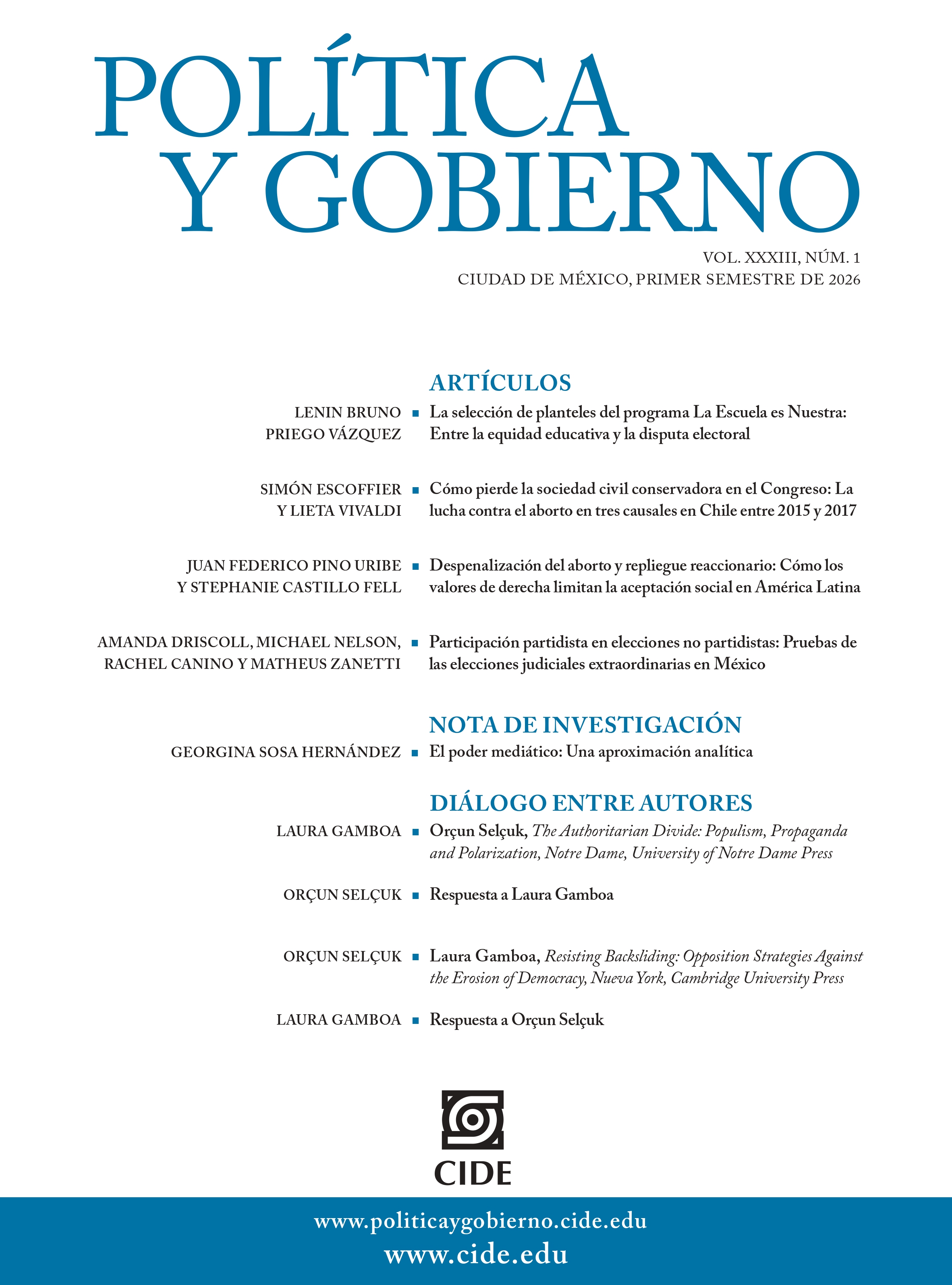
Participación partidista en elecciones no partidistas: Pruebas de las elecciones judiciales extraordinarias en México
Palabras clave:
Federal Judicial Power, direct elections of the federal judiciary of Mexico, judicial elections, MexicoResumen
This study analyzes Mexico’s unprecedented direct election of judicial authorities across federal and subnational levels on June 1, 2025. Although framed as a democratization effort, the reform resulted in significant consolidation of judicial power by the ruling party. Using a combination of official section-level vote returns and original survey data, we show that turnout was higher in areas supportive of the president, while spoiled ballots were more common in opposition strongholds, suggesting that low participation reflected political dissent more than confusion or lack of information. Despite rules prohibiting campaigns and partisan affiliation of candidates, the best predictor of candidate success was appearing on a government-aligned “voter guide” (acordeón), particularly in pro-government areas. Ballot design also conveyed executive preferences and incumbency status, reinforcing partisan patterns in what was technically an election where partisanship was prohibited. Although the long-term effects of these unprecedented judicial reforms are yet to be seen, this evidence suggests that this electoral process stands to undermine judicial independence and the separation of powers.
Descargas
Publicado
Número
Sección
Licencia
Política de acceso abierto
Los autores/as que publiquen en esta revista aceptan las siguientes condiciones:
De acuerdo con la legislación de derechos de autor, Política y gobierno reconoce y respeta el derecho moral de los autores, así como la titularidad del derecho patrimonial, el cual será cedido a la revista para su difusión en acceso abierto. Política y gobierno no realiza cargos a los autores por enviar y procesar artículos para su publicación.
Todos los textos publicados por Política y gobierno –sin excepción– se distribuyen amparados bajo la licencia Creative Commons 4.0 Atribución-No Comercial (CC BY-NC 4.0 Internacional), que permite a terceros utilizar lo publicado siempre que mencionen la autoría del trabajo y a la primera publicación en esta revista.
Los autores/as pueden realizar otros acuerdos contractuales independientes y adicionales para la distribución no exclusiva de la versión del artículo publicado en Política y gobierno (por ejemplo incluirlo en un repositorio institucional o publicarlo en un libro) siempre que indiquen claramente que el trabajo se publicó por primera vez en Política y gobierno.
Para todo lo anterior, el o los autor(es) deben remitir el formato de Carta-Cesión de la Propiedad de los Derechos de la primera publicación debidamente requisitado y firmado por el autor(es). Este formato se puede enviar por correo electrónico en archivo pdf al correo: politicaygobierno@cide.edu (Carta-Cesión de Propiedad de Derechos de Autor).

Este obra está bajo una licencia de Creative Commons Reconocimiento-No Comercial 4.0 Internacional.






 Contacto