
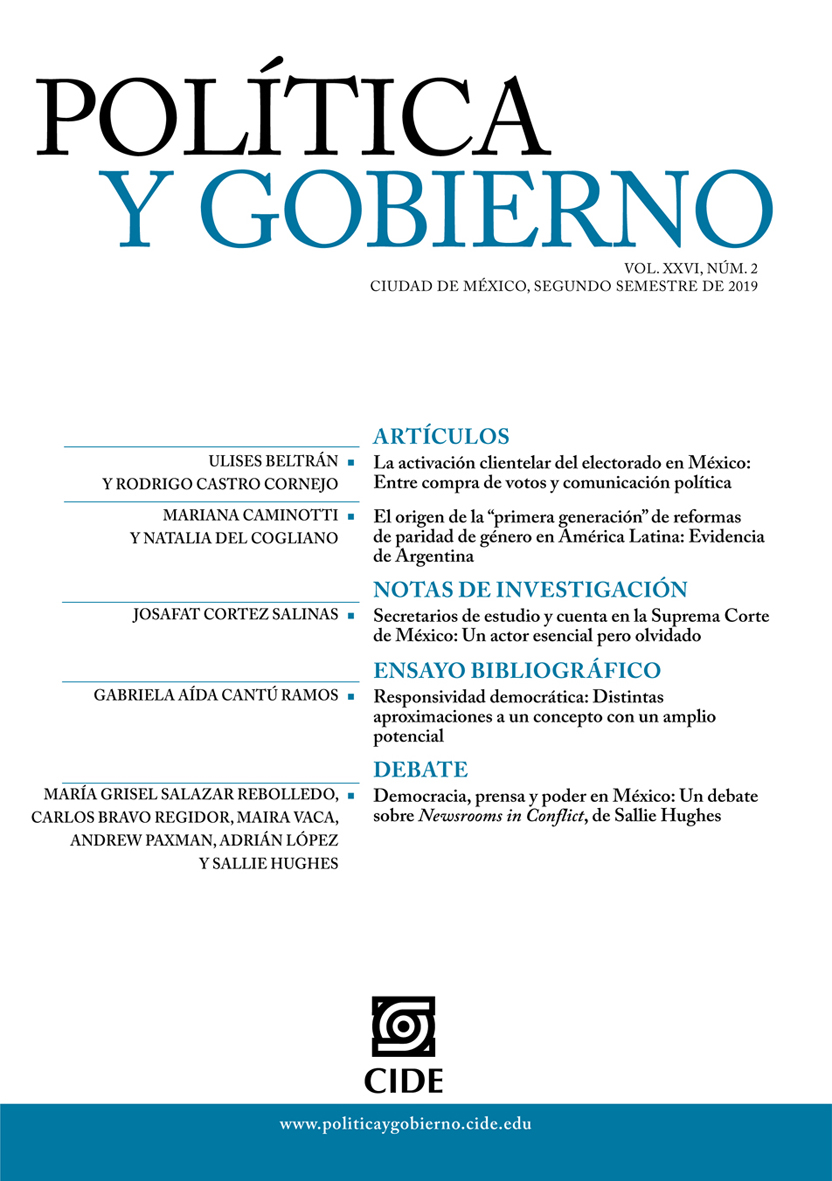
La activación clientelar del electorado en México entre compra de votos y comunicación política - Clientelistic Activation of Mexican Voters: Between Vote Buying and Political Communication
Keywords:
opinión pública, compra de voto, campañas, elecciones, México.Abstract
Este artículo analiza las estrategias clientelares partidistas en el contexto de la modernizción de las campañas en democracias jóvenes como México. Argumentamos que los partidos en México usan estrategias clientelares intensamente debido a dos factores combinados: a) reformas electorales que crearon incentivos para que los partidos puedan invertir mucho de su financiamiento público en estrategias de contacto directo y b) la adaptación de estrategias modernas de contacto directo que les permiten maximizar la distribución de regalos electorales como parte integral de la comunicación política en las campañas. Este tipo de contacto clientelar no se distribuye principalmente por la tradicional maquinaria electoral partidista que focaliza sus esfuerzos en los electores de menor nivel socioeconómico. Los partidos en México han adaptado técnicas modernas de campaña para crear una red efectiva de alcance clientelar como parte integral de la comunicación política. La evidencia de este artículo se encuentra en una encuesta original levantada durante la elección presidencial de 2012 y en el Estudio Nacional Electoral 2015 (cide-cses).
This research analyses the clientelistic outreach in the context of modern campaigns in new democra- cies like Mexico. We argue that Mexican parties intensely engage in clientelistic practices due to two combined factors: a) electoral reforms that created incentives for parties to invest heavily on direct contact campaign strat- egies and b) adaptation of modern campaigning get-out-the-vote campaign operations (gotv) that enable them to maximize the distribution of electoral gifts as part of their political communication strategy. This type of cli- entelism is not distributed by traditional machine politics targeting the poor. Instead, parties in Mexico have adapted modern political campaigning creating an effective network of clientelistic outreach. The empirical evidence for this article comes from an original survey conducted during the 2012 presidential election and the 2015 National Electoral Study (cide-cses).
Published
Issue
Section
License
The authors who publish in this journal agree on the following conditions:
In accordance with copyright laws, Política y gobierno recognizes and respects the authors’ moral rights, as well as the ownership of property rights, which will be transferred to the journal for its dissemination in open access. Política y gobierno does not charge the authors for submitting and processing articles for publication.
All the articles published in Política y gobierno —with no exception— are distributed under a Creative Commons License 4.0 Attribution Non-Commercial (CC BY-NC 4.0 International), that allows third parties to use the published work providing they mention the authorship of the work and the first publication in this journal.
The authors can enter into other independent and additional contractual arrangements for the non-exclusive distribution of the version of the article published in Política y gobierno (for example to include it into an institutional repository or publish it in a book) as lomg as it is clearly indicated that the work was published for the first time in Política y gobierno.
For all of the above, the author(s) must submit the Format of transfer of the ownership of the first publishing rights duly filled in and signed by the author(s). This format can be sent as a pdf by e-mail: politicaygobierno@cide.edu (Letter- transfer of property rights)

This work is licensed under a Creative Commons Attribution-Noncommercial 4.0 International.






 Contact