
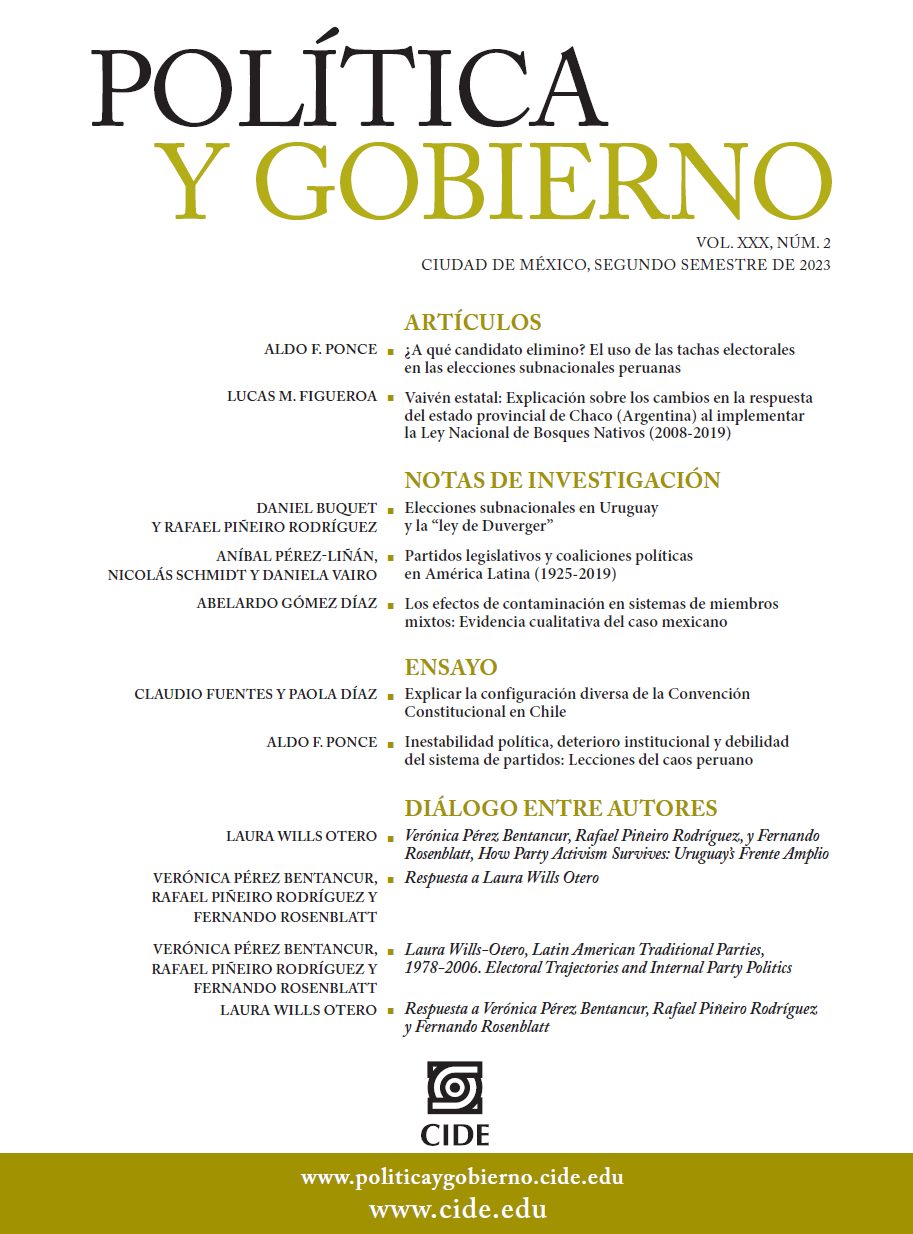
Subnational Elections in Uruguay and the “Duverger’s Law”
Keywords:
electoral systems, party systems, electoral coordination, UruguayAbstract
The 1996 electoral reform in Uruguay separated national form the subnational elections. Both elections are held six months apart, but by different electoral systems: two round majority for presidential elections, and plurality for the elections of departmental mayors. In this context, parties that compete in the two elections are strictly the same and the electorates are practically identical. This makes it possible to compare the electoral results in each constituency with a system that encourages strategic behaviors and other that do not. The estimated results point out a robust reducing effect of the plurality system on the effective number of parties and show the effects of strategic behaviors of parties and voters under this electoral system.
Downloads
Published
Issue
Section
License
The authors who publish in this journal agree on the following conditions:
In accordance with copyright laws, Política y gobierno recognizes and respects the authors’ moral rights, as well as the ownership of property rights, which will be transferred to the journal for its dissemination in open access. Política y gobierno does not charge the authors for submitting and processing articles for publication.
All the articles published in Política y gobierno —with no exception— are distributed under a Creative Commons License 4.0 Attribution Non-Commercial (CC BY-NC 4.0 International), that allows third parties to use the published work providing they mention the authorship of the work and the first publication in this journal.
The authors can enter into other independent and additional contractual arrangements for the non-exclusive distribution of the version of the article published in Política y gobierno (for example to include it into an institutional repository or publish it in a book) as lomg as it is clearly indicated that the work was published for the first time in Política y gobierno.
For all of the above, the author(s) must submit the Format of transfer of the ownership of the first publishing rights duly filled in and signed by the author(s). This format can be sent as a pdf by e-mail: politicaygobierno@cide.edu (Letter- transfer of property rights)

This work is licensed under a Creative Commons Attribution-Noncommercial 4.0 International.






 Contact