
Movilizing Ethnicity. A theoretical Review with Applications to the Fourth Wave of Indigeneous Mobilizations in Latin America
Keywords:
indigenous people, peasants, ethnical identities, mobilization, conflict, Latin AmericaAbstract
This research note presents a critical review of the main theoretical explanations of ethnic identity formation and mobilization and of the most influential accounts of the wave of indigenous mobilizations that took off in most Latin American countries in the mid 1970s. The review covers theories and approaches that use different epistemological assumptions (structure, culture and sintrumental rationality) and methodological approaches (quantitative, formal and case studies). Each theory is assessed according to its causal logic, evidence and explanatory power. Threee conclusions follow. First: the Latin American cases have been grossly ignored in ethnic theorizing in comparative politics and sociology. A a result, most ethnic theorizing is statistically biased. Second: most interpretations of indigenous mobilizations in Latin America have stayed away from the main theoretical and methodological debates in comparative politics. Therefore, most of them are methodologically weak. Finally, all hypotheses on indigenous mobilization that have emergerd in past decades need to be put to systematic testing.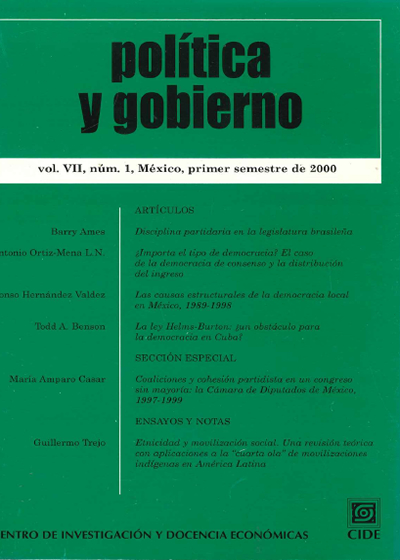
Downloads
Issue
Section
License
The authors who publish in this journal agree on the following conditions:
In accordance with copyright laws, Política y gobierno recognizes and respects the authors’ moral rights, as well as the ownership of property rights, which will be transferred to the journal for its dissemination in open access. Política y gobierno does not charge the authors for submitting and processing articles for publication.
All the articles published in Política y gobierno —with no exception— are distributed under a Creative Commons License 4.0 Attribution Non-Commercial (CC BY-NC 4.0 International), that allows third parties to use the published work providing they mention the authorship of the work and the first publication in this journal.
The authors can enter into other independent and additional contractual arrangements for the non-exclusive distribution of the version of the article published in Política y gobierno (for example to include it into an institutional repository or publish it in a book) as lomg as it is clearly indicated that the work was published for the first time in Política y gobierno.
For all of the above, the author(s) must submit the Format of transfer of the ownership of the first publishing rights duly filled in and signed by the author(s). This format can be sent as a pdf by e-mail: politicaygobierno@cide.edu (Letter- transfer of property rights)

This work is licensed under a Creative Commons Attribution-Noncommercial 4.0 International.






 Contact