
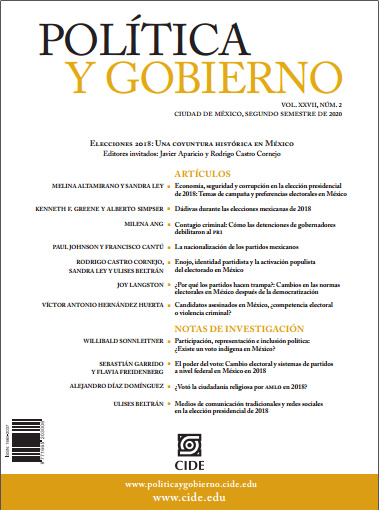
Elecciones 2018. Una coyuntura histórica en México
Keywords:
IntroduccionAbstract
El resultado de la jornada electoral del 1 de julio de 2018 puede considerarse histórico desde varios puntos de vista. Si bien el triunfo de Andrés Manuel López Obrador se pronosticaba desde semanas atrás por la mayoría de las encuestas, su contundencia fue sorprendente para muchos: 53.2 por ciento del voto nacional y una holgada mayoría para su coalición partidista en ambas cámaras del Congreso.
References
Abramowitz, Alan I. (2018), The Great Alignment: Race, Party Transformation, and the Rise of Donald Trump, New Haven y Londres: Yale University Press.
Abramowitz, Alan I. y Steven W. Webster (2018), “Negative Partisanship: Why Americans Dislike Parties but Behave Like Rabid Partisans”, Political Psychology, 39(S1), pp. 119135.
Baker, Andy y Lucio Renno (2019), “Nonpartisans as False Negatives: The mismeasurement of Party Identifcation in Public Opinion Surveys”, The Journal of Politics, 81(3), pp. 906922.
Baker, Andy, Barry Ames, Anand E. Sokhey y Lucio Renno (2016), “The Dynamics of Partisan Identifcation when Party Brands Change: The Case of the Workers Party in Brazil”, Journal of Politics, 78(1), pp. 197213.
Beltrán, Ulises (1997), “Encuesta nacional sobre el votante mexicano: Primeros resultados”, Política y Gobierno, IV(2), pp. 407420.
Beltrán, Ulises (2007), “Contextos institucionales y decisiones individuales: Cuarta encuesta nacional cidecses”, Política y Gobierno, XIV(2), pp. 467490.
Beltrán, Ulises (2009a), “Ideología y polarización en la elección de 2006”, Política y Gobierno, volumen temático, pp. 83106.
Beltrán, Ulises (2009b), “Introducción: El proceso electoral: precampañas, campañas y resultado”, Política y Gobierno, volumen temático, pp. 539.
Beltrán, Ulises y Rodrigo Castro Cornejo (2019), “La activación clientelar del electorado en México: Entre compra de votos y comunicación política”, Política y Gobierno, XXVI(2), pp. 171204.
Beltrán, Ulises, Sandra Ley, Rodrigo Castro Cornejo (2020), Encuesta Nacional Electoral (CIDE_CSES) 2018, México: Centro de Investigación y Docencia Económicas.
Botero, Sandra, Rodrigo Castro Cornejo, Laura Gamboa, Nara Pavao y David W. Nickerson (2015), “Says Who? An Experiment on Allegations of Corruption and Credibility of Sources”, Political Research Quarterly, 68(3), pp. 493504.
Bruhn, Kathleen (2012), “‘To Hell with Your Corrupt Institutions!’: AMLO and Populism in Mexico”, en Cas Mudde y Cristóbal Rovira (eds.), Populism in Europe and the Americas: Threat or Corrective for Democracy, Cambridge: Cambridge University Press, pp. 88112.
Bruhn, Kathleen y Kenneth F. Greene (2007), “Elite Polarization Meets Mass Moderation in Mexico’s 2006 Elections”, ps: Political Science & Politics, 40(1), pp. 3338.
Cameron, Maxwell A. (1994), Democracy and Authoritarianism in Peru: Political Coalitions and Social Change, Nueva York: Macmillan
Campbell, Angus, Philip E. Converse, Warren E. Miller y Donald E. Stokes (1960), The American Voter, Nueva York: John Wiley & Sons.
Castro Cornejo, Rodrigo (en prensa), “Shortterm or LongPartisanship? Campaign Effects and the Stability of Party Identifcation in Latin America”, Latin American Research Review.
Converse, Philip E. (2006), “The Nature of Belief Systems in Mass Publics”, Critical Review, 18(13), pp. 174.
Cyr, Jennifer (2017), “The Fates of Political Parties: Institutional Crisis, Continuity, and Change in Latin America”, Cambridge: Cambridge University Press.
De Vries, Catherine E. y Hector Solaz (2017), “The Electoral Consequences of Corruption”, Annual Review of Political Science, 20, pp. 391408.
Ellis, Christopher y James A. Stimson (2012), Ideology in America, Nueva York: Cambridge University Press.
Fiorina, Morris P. (1981), Retrospective Voting in American National Elections, New Haven: Yale University Press.
Green, Donald Philip, Bradley Palmquist y Eric Schickler (2002), Partisan Hearts and Minds: Political Parties and the Social Identities of Voters, New Haven: Yale University Press.
Iyengar, Shanto y Sean J. Westwood (2015), “Fear and Loathing Across Party Lines: New Evidence on Group Polarization”, American Journal of Political Science, 59(3), pp. 690707.
Iyengar, Shanto, Gaurav Sood y Yphtach Lelkes (2012), “Affect, Not Ideology: A Social Identity Perspective on Polarization”, Public Opinion Quarterly, 76(3), pp. 405431.
Iyengar, Shanto, Yphtach Lelkes, Mathew Levendusky, Neil Malhotra y Sean J. Westwood (2019), “The Origins and Consequences of Affective Polarization in the United States”, Annual Review of Political Science, 22, pp. 129146.
LewisBeck, Michael S., William G. Jacoby, Helmut Norpoth, y Herbert F. Weisberg (2008), The American Voter Revisited, Ann Arbor: University of Michigan Press.
Lupu, Noam (2013), “Party Brands and Partisanship: Theory with Evidence from a Survey Experiment in Argentina”, American Journal of Political Science, 57(1), pp. 4964.
Lupu, Noam (2014), “Brand Dilution and the Breakdown of Political Parties in Latin America”, World Politics, 66(4), pp. 561602.
Lupu, Noam (2015), “Partisanship in Latin America”, en Ryan E. Carlin, Matthew M. Singer y Elizabeth J. Zechmeister (eds.), The Latin American Voter: Pursuing Representation and Accountability in Challenging Contexts, Ann Arbor: University of Michigan Press, pp. 226245.
Lupu, Noam (2016), Party Brands in Crisis: Partisanship, Brand Dilution, and the Breakdown of Political Parties in Latin America, Nueva York: Cambridge University Press.
Mainwaring, Scott (ed.) (2018), Party Systems in Latin America: Institutionalization, Decay, and Collapse, Cambridge: Cambridge University Press.
Mason, Lilliana (2018a), “Ideologues without Issues: The Polarizing Consequences of Ideological Identities”, Public Opinion Quarterly, 82(S1), pp. 866887.
Mason, Lilliana (2018b), Uncivil Agreement: How Politics Became our Identity, Chicago y Londres: University of Chicago Press.
Moreno, Alejandro (2015), El votante mexicano: Democracia, actitudes políticas y conducta electoral, Ciudad de México: Fondo de Cultura Económica.
Moreno, Alejandro (2018), El cambio electoral: Votantes, encuestas y democracia en México, Ciudad de México: Fondo de Cultura Económica.
Morgan, Jana (2011), Bankrupt Representation and Party System Collapse, University Park: Pennsylvania State University Press.
Noel, Hans (2014), Political Ideologies and Political Parties in America, Nueva York: Cambridge University Press.
Sánchez y Sánchez, Carlos (2019), “El clivaje redistributivo: Ideología y redistribución social”, en Alejandro Moreno, Alexandra Uribe y Sergio Wals (coords.), El iraje electoral: Opinión pública y voto en las elecciones de 2018, Ciudad de México: Centro de Estudios Sociales y de Opinión Pública.
Seawright, J. (2012), Party-system Collapse: The Roots of Crisis in Peru and Venezuela, Stanford: Stanford University Press.
Stimson, James A. (1999), Public Opinion in America: Moods, Cycles, and Swings, 2a. ed., Boulder: Westview Press.
Zaller, John R. (1992), The Nature and Origins of Mass Opinion, Nueva York: Cambridge University Press.
Downloads
Published
Issue
Section
License
The authors who publish in this journal agree on the following conditions:
In accordance with copyright laws, Política y gobierno recognizes and respects the authors’ moral rights, as well as the ownership of property rights, which will be transferred to the journal for its dissemination in open access. Política y gobierno does not charge the authors for submitting and processing articles for publication.
All the articles published in Política y gobierno —with no exception— are distributed under a Creative Commons License 4.0 Attribution Non-Commercial (CC BY-NC 4.0 International), that allows third parties to use the published work providing they mention the authorship of the work and the first publication in this journal.
The authors can enter into other independent and additional contractual arrangements for the non-exclusive distribution of the version of the article published in Política y gobierno (for example to include it into an institutional repository or publish it in a book) as lomg as it is clearly indicated that the work was published for the first time in Política y gobierno.
For all of the above, the author(s) must submit the Format of transfer of the ownership of the first publishing rights duly filled in and signed by the author(s). This format can be sent as a pdf by e-mail: politicaygobierno@cide.edu (Letter- transfer of property rights)

This work is licensed under a Creative Commons Attribution-Noncommercial 4.0 International.






 Contact